
Tagalog Grammar: SA Markers
In Filipino grammar, SA markers are used to point out locations, directions, recipients, and objects of certain prepositions. Just like ANG markers (for topics) and NG markers (for actors or objects), the SA group plays a very important role in building natural Tagalog sentences.
Think of SA markers as pointing to the destination, receiver, or location of the action. They often appear after verbs or objects to complete the meaning of a sentence. These markers usually answer the question words who, whom and whose.
The SA Markers
| sa | + singular place, location or direction |
| sa mga | + plural place, location or direction |
| kay | + singular personal name |
| kina | + plural people’s names |
Functions of SA Markers
- SA marks a location (where something happens or where someone is going); it also marks an indirect object (who receives something) and the direction of movement.
- Uupo ako sa upuan. (I’ll sit on the chair.) → location
- Nagbigay siya ng pera sa tindera. (He gave money to the vendor.) → indirect object
- Pumunta kami sa probinsya. (We went to the province.) → direction
- SA MGA plays a similar role in Tagalog sentences but it is used for plural nouns.
- Nagbigay kami ng regalo sa mga matatanda. (We gave gifts to the elderly.)
- Nagpaalala ang coach sa mga manlalaro. (The coach reminded the players.)
- Magpapadala kami ng imbitasyon sa mga kaibigan namin. (We’ll send invitations to our friends.)
- KAY is used with singular proper names (people or sometimes animals) and marks the receiver or direction when the noun is a specific person.
- Nagpadala ako ng sulat kay Alice. (I sent a letter to Alice.)
- Lumapit siya kay Ginoong McNally. (He approached Mr. Santos.)
- Makipag-usap ka kay Randy. (Talk to Randy)
- KINA is the plural form of kay, used with two or more proper names and marks the receiver or place belonging to someone.
- Pumunta kami kina Pedro at Juan. (We went to Pedro and Juan’s place.)
- Dumiretso siya kina Erica at Verlin galing trabaho. (She went straight to Erica and Verlin’s house from work.)
- Naghatid ako ng pagkain kina Lola at Lolo. (I brought food to Grandma and Grandpa’s house.)
Key Grammar Points
– SA marks where someone or something is located, or the direction of movement and answers the question: Saan? (Where?).
– SA shows to whom or for whom something is given, shown, or done.
– SA MGA for plural receivers or indirect objects
– KAY is used for singular names of recipients or owners
– KINA is for plural names of recipients and also denotes someone’s house or place of residence
Related Videos

Tagalog markers KAY and KINA
Learn how to use Tagalog markers “kay” and “kina” when talking about people in Filipino! This video explains the difference between kay for one person and kina for multiple people, with clear, everyday examples that make it easy to understand.
See how these markers are used in sentences when referring to friends, family, or anyone you’re talking about, and get practical tips to use kay and kina correctly every time you speak or write Tagalog.
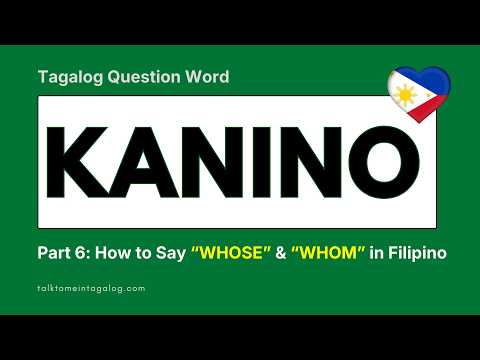
Tagalog question word KANINO
Learn how to use the Tagalog question word “kanino” to ask about people in Filipino! This video explains how kanino is used to mean “to whom” or “whose” in everyday conversations, with practical examples you can start using right away.
See how to ask questions naturally when talking about friends, family, or anyone in a sentence, and understand the common mistakes learners make so you can use kanino correctly every time.
Connect
Our YouTube Channels
Talk to Me in Tagalog
English-Tagalog Speaking Practice
Learn Filipino Language
OFW English Lessons
Want to support us?