
How to Say "Compared to" in Tagalog | KUMPARA in English
Learn how to say “compared to” in Tagalog when highlighting differences or similarities? This comprehensive Filipino language tutorial explores the versatile expression “Kumpara sa,” your key to making clear comparisons in conversation. Learn precisely how to use “Kumpara sa” in various Tagalog sentences, gaining a deep understanding of its vital grammar and appropriate placement. This Tagalog tutorial provides real-life examples with English translations, demonstrating how to naturally compare things in Filipino.
Mas matamis ang ubas kumpara sa mansanas. (Grapes are sweeter compared to apples.)
Mas maganda siya kumpara sa kapatid niya. (She’s prettier compared to her sister.)
Mas mainit ngayon kumpara sa kahapon. (It’s hotter today compared to yesterday.)
Mas konti ang tao ngayon kumpara noong nakaraang linggo. (There are fewer people now compared to last week.)
Mas malambot ang unang ‘to kumpara doon sa isa. (This pillow is softer than the other one.)
Mas makapal ang librong ito kumpara sa isa. (This book is thicker compared to the other one.)
Mas mura ang mga gulay sa Benguet kumapara sa Maynila. (Vegetables in Benguet are cheaper compared to Manila.)
Mas tahimik si Gerta kumpara kay Elsa. (Gerta is quieter compared to Elsa.)
Mas maganda ang tunog nito kumpara sa dati. (This sounds better than the old one.)
Mas mainit sa Libya kumpara sa Dubai. (It’s hotter in Libya compared to Dubai.)
Mas matipid na ako ngayon kumpara dati. (I’m more frugal now compared to before.)
Mas mabilis mag-type si Ahmad kumpara kay Joonie. (Ahmad types faster than Joonie.)
Mas makapal ang kumot na ito kumpara sa isa. (This blanket is thicker than the other one.)
Mas madilim ang kalsada rito kumpara sa kabilang barangay. (The road here is darker than the one in the other barangay.)
Mas masangsang ang amoy ng isda kumpara sa karne. (The smell of fish is stronger than that of meat.)
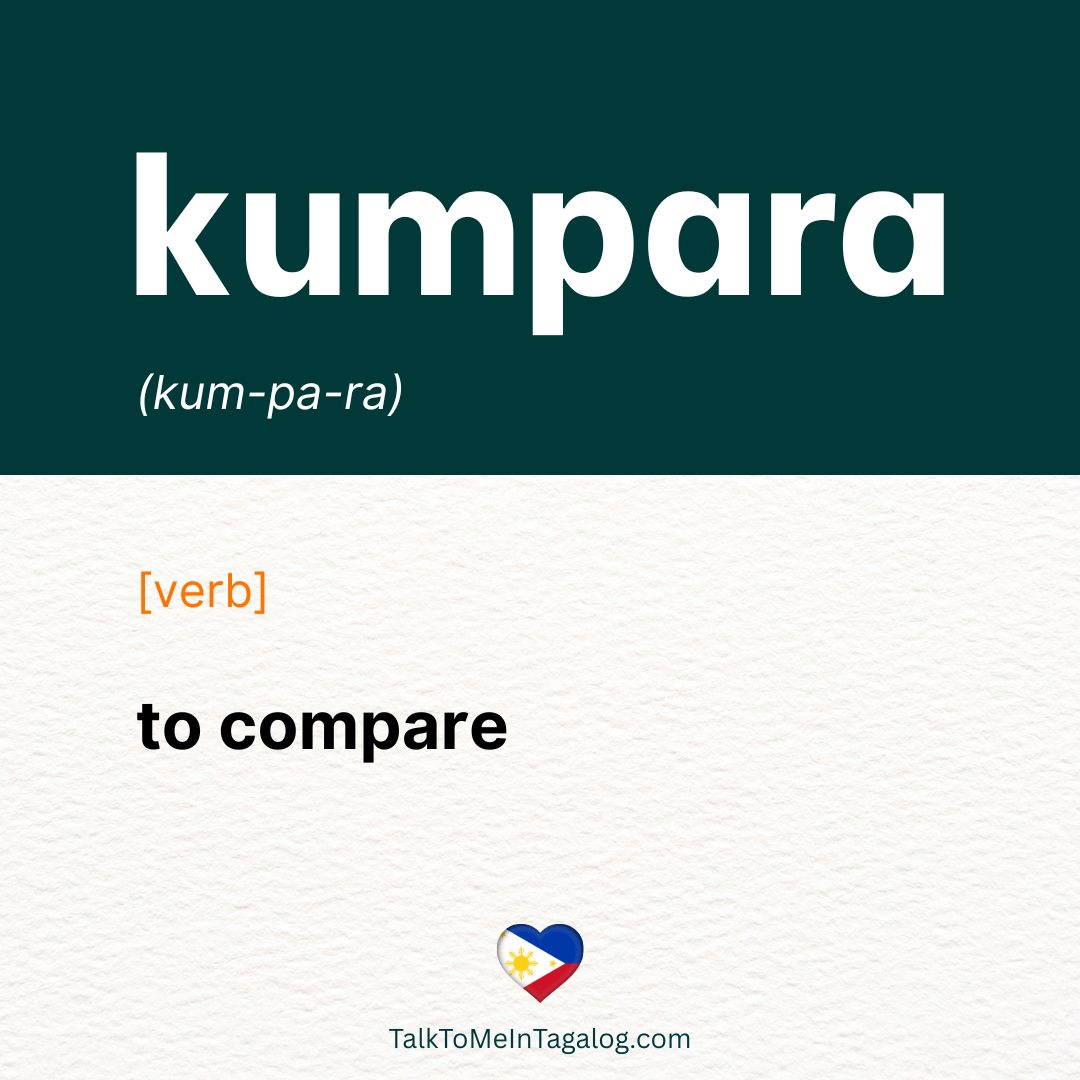
Featured Filipino Word
Mas paos ako ngayon kumpara kahapon. (My voice is raspier today than it was yesterday.)
Mas mabula ang sabong ito kumpara sa dati. (This soap is foamier than the old one.)
Mas makintab ang sahig ngayon kumpara kaninang umaga. (The floor is shinier now than it was earlier this morning.)
Mas mababa ang singil nila kumpara sa ibang pagawaan. (Their charge is lower than the other repair shops’.)
Mas malutong ang lechon dito kumpara sa kabilang karinderya. (The lechon here is crispier than at the other eatery.)
Mas puno ang palengke tuwing Sabado kumpara sa Linggo. (The market is more crowded on Saturdays than Sundays.)
Mas magaspang ang papel na ‘to kumpara doon sa isa. (This paper is rougher than the other one.)
Mas mainit ang panahon ngayon kumpara noong Lunes. (The weather is hotter now than it was Monday.)
Mas maluwag ang damit na ‘to kumpara sa suot ko kahapon. (This dress is looser than the one I wore yesterday.)
Mas mabilis naghilom ang sugat mo kumpara sa kanya. (Your wound healed faster than his.)
Mas trapik sa EDSA kumpara sa C5. (There’s more traffic on EDSA than on C5.)
Mas maputik ngayon kumpara kahapon. (It’s muddier today than it was yesterday.)
Mas matalas ang kutsilyo ni Nanay kumpara sa gamit ko. (Mom’s knife is sharper than the one I use.)
Mas mura ang pamasahe sa jeep kumpara sa tricycle. (The jeepney fare is cheaper than the tricycle’s.)
Mas mabilis makatulog si Tito kumpara kay Tita. (Uncle falls asleep faster than Auntie.)
Mas mabilis mapuno ang maliit na balde kumpara sa malaki. (The small bucket fills up faster than the big one.)
Mas mabilis masira ang mumurahing charger kumpara sa branded. (Cheap chargers break faster than branded ones.)
Watch more Tagalog Learning Videos
Looking to say “more than” in Tagalog? Learn how to use “mas” to make comparisons in Filipino, along with natural sentence examples.
Want to express the superlative degree in Tagalog? Learn how to use “pinaka-” to say things like “the most” or “the best” in natural Filipino sentences.
Ready to speak Tagalog? This video packs 500 essential English-Tagalog phrases to kickstart your fluency. Learn practical vocabulary for everyday conversations.
Connect
Our YouTube Channels
Talk to Me in Tagalog
English-Tagalog Speaking Practice
Learn Filipino Language
OFW English Lessons
Want to support us?