
How to Say "Almost" or "Nearly" in Tagalog | HALOS in English
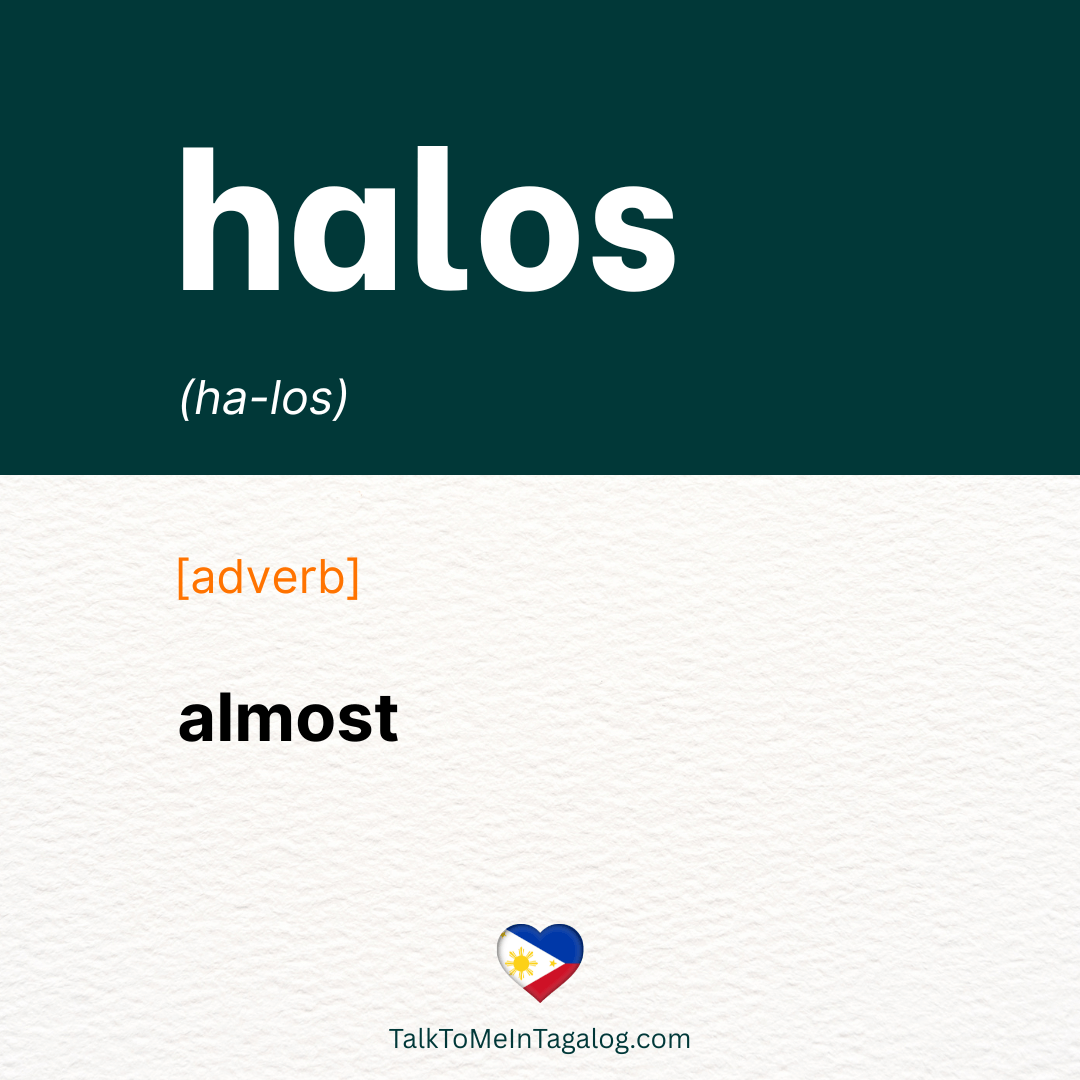
How to say “almost” or “nearly” in Tagalog is done with the word “halos,” a simple but versatile adverb used to describe things that are nearly happening, almost complete, or closely resembling something. In real conversations, Filipinos sprinkle halos into sentences to express approximation in a natural way. With practical example sentences and English translations, you can see exactly how halos works in context, helping you describe situations more accurately and sound more fluent when speaking Filipino.
Halos hindi na ako makahinga. (I could barely breathe.)
Halos mamatay ako sa kaba. (I almost died of nervousness.)
Halos kalahating milyon ang gastos. (It cost nearly half a million.)
Halos hindi ko na siya makilala. (I could barely recognize him.)
Halos napaiyak ako sa inis. (I was almost in tears from frustration.)
Halos pareho ang presyo ng dalawang iyon. (The two of them are almost the same price.)
Halos liparin ng hangin ang sombrero ko sa lakas ng hangin. (The wind almost blew my hat away.)
Halos mabingi ako sa lakas ng tugtog. ( I was almost deafened by the loud music.)
Halos mawalan ako ng boses sa kasisigaw. (I almost lost my voice from shouting.)
Halos sumuko na ako noon. (I almost gave up back then.)
Halos hindi ko siya nakilala. (I almost didn’t recognize him.)
Featured Filipino Word
Halos nagkakandarapa ang mga tao sa sale. (People were almost scrambling at the sale.)
Halos walang tigil ang ulan. (The rain was almost nonstop.)
Halos wala siyang kinain. (She barely ate anything.)
Halos lahat ng kaibigan ko ay may trabaho na. (Almost all of my friends already have jobs.)
Halos bumigay ang tuhod ko sa takot. (My knees almost gave out from fear.)
Halos hindi namin makita ang daan sa kapal ng hamog. (We could barely see the road because of the thick fog.)
Halos sumabog ang bag niya sa dami ng laman. (Her bag was almost bursting with stuff.)
Halos sumuka siya sa hilo. (He almost threw up from dizziness.)
Halos tumigil ang mundo ko sa narinig ko. (My world almost stopped from what I heard.)
Halos hindi kumurap ang bata sa panonood. (The kid barely blinked while watching.)
Halos wala na kaming makitang parking. (We could hardly find any parking.)
Halos hindi mo maramdaman ang hangin. (You could barely feel the wind.)
Halos mapuno ng tao ang aklatan. (The library was almost packed with people.)
Halos walang pahinga ang mga manggagawa. (The workers had almost no break.)
Halos pumutok ang lobo sa laki. (The balloon almost burst from how big it was.)
Halos hindi marinig ang boses niya sa sobrang hina. (You could barely hear his voice because it was so soft.)
Halos wala siyang kibo buong araw. (He barely spoke all day.)
Halos gumapang na siya sa pagod. (He was almost crawling from exhaustion.)
Halos hindi na siya makalakad sa sakit. (He could barely walk because of the pain.)
Halos parehas ang problema natin. (Our problems are almost the same.)
Halos hindi kami makapaniwala sa balita. (We could hardly believe the news.)
Halos mabasag ang salamin sa lakas ng hangin. (The glass almost broke from the strong wind.)
Halos puro mali ang sagot ko. (My answers were almost all wrong.)
Halos hindi umuusad ang mga sasakyan sa kalsada. (Halos hindi umuusad ang mga sasakyan sa kalsada.)
Halos mamilipit ako sa tawa. (I was almost doubled over with laughter.)
Halos pareho ang reaksyon nila. (Their reactions were nearly identical.)
Halos wala nang laman ang garapon. (The jar is almost empty.)
Halos limandaang tao ang dumalo sa okasyon. (There were almost 500 people at the event.)
Halos magpantay ang puntos nila. (Their scores were almost equal.)
Watch more Tagalog Learning Videos
Looking for how to say “a little” or “a bit” in Tagalog? Learn how to use “medyo” naturally in Filipino to soften statements or express slight amounts.
Want to say “there is” or “there are” in Tagalog? Learn how to use “may” in Filipino to talk about existence, availability, and possession in daily conversation.
Wondering how to say “became” in Tagalog? Learn how to use “naging” to express changes in state or condition in natural Filipino sentences.
Connect
Our YouTube Channels
Talk to Me in Tagalog
English-Tagalog Speaking Practice
Learn Filipino Language
OFW English Lessons
Want to support us?