
How to Say "Often" in Tagalog | MADALAS in English
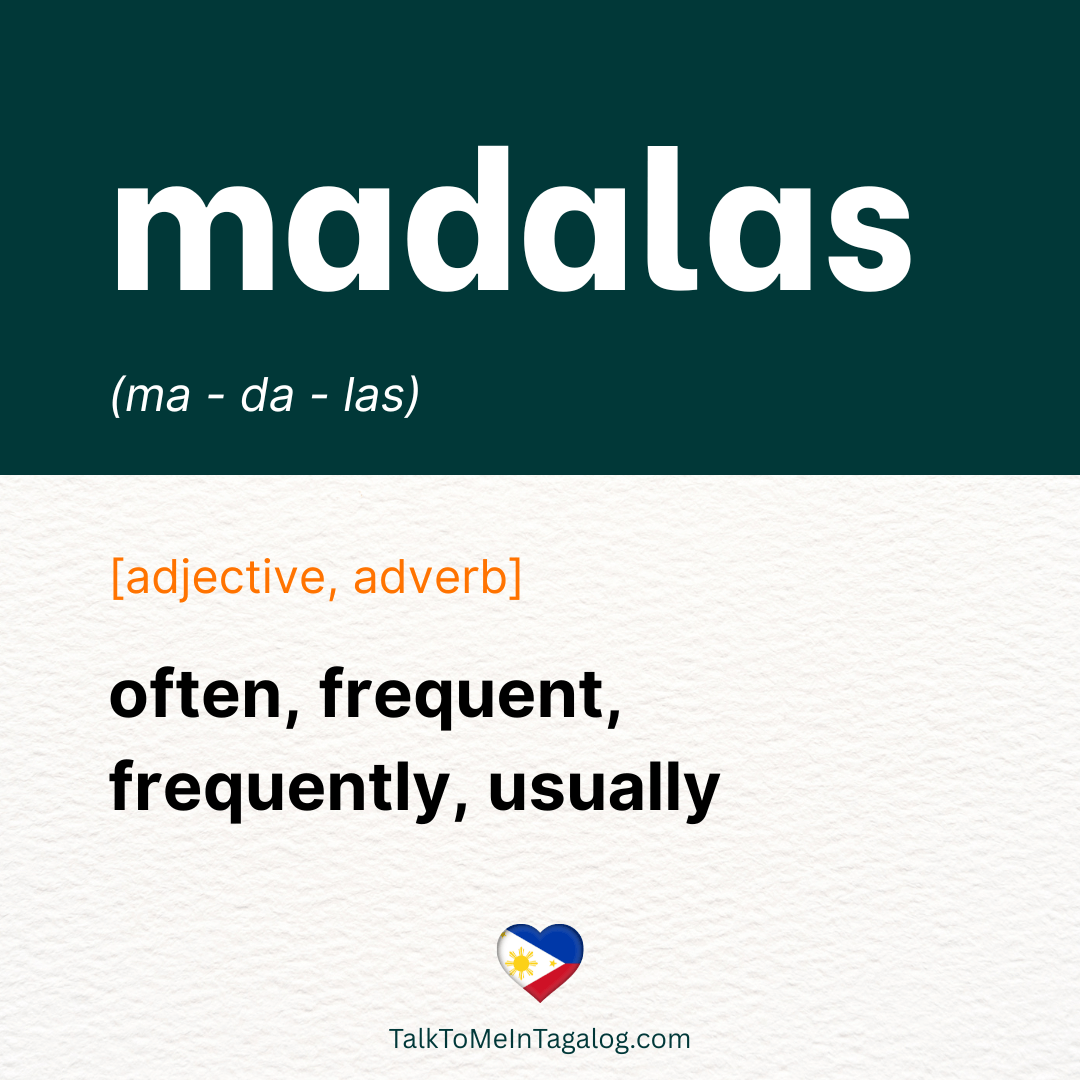
How do you say “often” or “frequently” in Tagalog? This Filipino lesson explains how to use “madalas,” a key Tagalog word for talking about regular habits, repeated actions, and things that happen again and again. You’ll get a clear understanding of what madalas means and see how it’s used naturally in everyday conversations. With practical Tagalog sentence examples and English translations, this lesson helps you speak more naturally and talk about routines, patterns, and common events with confidence.
Madalas umulan sa lugar na ito. (It often rains in this area.)
Madalas naming pag-usapan ‘yon. (We often talk about it.)
Madalas sumakit ang ulo ko. (I often get headaches.)
Madalas kaming magkita sa palengke.. (We often run into each other at the market.)
Madalas kaming may meeting tuwing Lunes. (We often have meetings on Mondays.)
Madalas silang mag-away sa maliliit na bagay. (They often argue about small things.)
Madalas kaming mag-bowling ng mga kaibigan ko. (My friends and I often go bowling.)
Featured Filipino Word
Madalas niya akong kumustahin. (She often checks in to see how I’m doing.)
Madalas niyang makalimutan ang pangalan ng mga tao. (He often forgets people’s names.)
Madalas kaming magl-pingpong ng mga pinsan ko tuwing Linggo. (My cousins and I often play ping pong on Sundays.)
Madalas kaming mag-road trip tuwing tag-init. (We often take road trips in the summer.)
Madalas siyang mamili online. (She often shops online.)
Madalas akong magkumpara ng mga presyo bago bumili. (I often compare prices before buying something.)
Madalas silang mag-post ng mga litrato ng biyahe nila. (They often post pictures from their trip.)
Diligan mo nang madalas ang mga halaman para laging basa ang lupa. (Water the plants often enough to keep the soil moist.)
Madalas siyang makinig ng music habang nagtatrabaho. (He often listens to music while working.)
Madalas kong mawala ang salamin ko kapag nagmamadali ako. (I often misplace my glasses when I’m in a hurry.)
Madalas niyang makalimutan ang mga password niya. (She often forgets her passwords.)
Madalas akong magtapon ng basura sa gabi. (I often take out the trash at night.)
Madalas siyang magbago ng isip sa bandang huli. (She often changes her mind at the last minute.)
Madalas ka bang manood ng pelikula sa gabi?. (Do you often watch movies at night?)
Madalas ka bang mag-text sa mga kaibigan mo? (Do you often text your friends?)
Madalas niyang pabayaan umaagaos ang tubig sa gripo. (She often leaves the water running from the faucet.)
Madalas kong makalimutan kung bakit ako pumasok sa kwarto. (I often forget why I walked into a room.)
Madalas akong makatulog habang nanonood ng TV. (I often fall asleep while watching TV.)
Madalas silang humiram ng gamit sa kapitbahay. (They often borrow tools from their neighbors.)
Hindi naman madalas mangyari ‘yon? (Does that happen often?)
Mas madalas siyang mag-travel kaysa sa akin. (He travels more often than I do.)
Watch more Tagalog Learning Videos
Explore common Filipino adjectives with the “ma-” prefix, such as mabait, masaya, and malinis. Learn how these Tagalog adjectives describe people, emotions, and things in daily life.
Learn essential Tagalog UM- verbs related to bodily movements, like tumayo, umupo, and lumakad. Discover how these action words work in natural Filipino sentences.
Connect
Our YouTube Channels
Talk to Me in Tagalog
English-Tagalog Speaking Practice
Learn Filipino Language
OFW English Lessons
Want to support us?