
How to Say "Still," "Yet," or "More" in Tagalog | PA in English
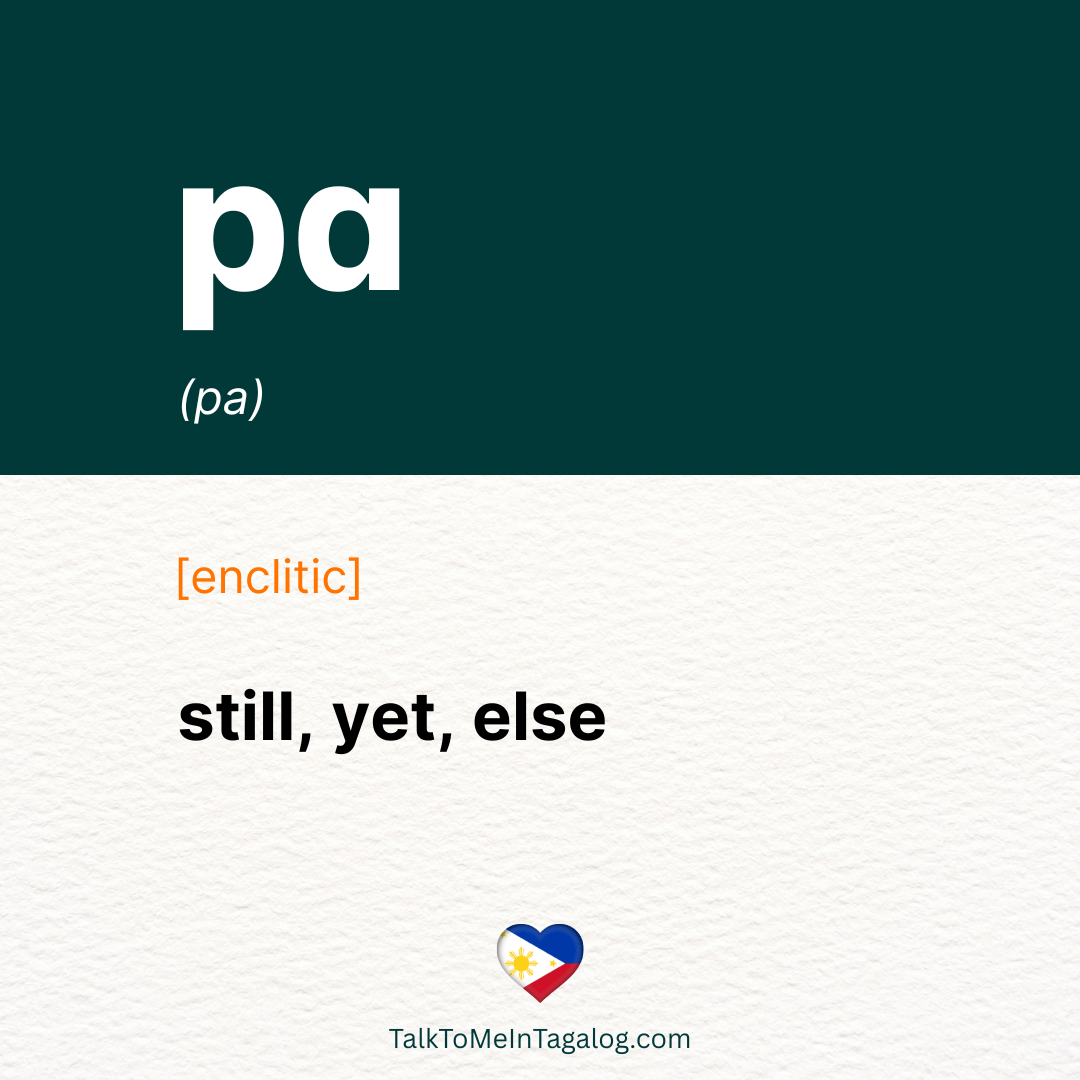
Wondering how to say “still,” “more,” “yet” or “else” in Tagalog to describe ongoing actions or unfinished states? This Filipino language tutorial explains the Tagalog word “Pa” that Filipinos use to express continuity, remaining quantity, or an action still pending. Learn how this particle works in daily conversation through practical Tagalog sentences translated to English.
How to Say STILL, YET or MORE in Filipino: Watch this Tagalog Lesson for Beginners
→ “Pa” meaning “Still” (Ongoing Action/State)
Kumakain pa siya. (He’s still eating.)
Tulog pa ang mga bata. (The children are still asleep.)
Buhay pa ang mga lolo’t lola ko. (My grandparents are still alive.)
Gumagana pa ang kotse. (The car is still working.)
Mainit pa ang kape. (The coffee is still hot.)
Nandito pa si Nathalie. (Nathalie is still here.)
Bata pa siya. (She’s still young.)
Gising pa ba siya? (Is he still awake?)
Sariwa pa rin ang mga gulay. (The vegetables are still fresh.)
Featured Filipino Word
→ “Pa” meaning “Yet” (Not Yet, Not Finished)
Hindi pa ako tapos. (I’m not finished yet.)
Wala pa si Malia. (Malia isn’t here yet.)
Wala pa akong pera. (I don’t have money yet.)
Hindi pa sila dumadating. (They haven’t arrived yet.)
Hindi ko pa alam. (I don’t know yet.)
Hindi pa siya tapos kumain. (He hasn’t finished eating yet.)
Wala pa siyang bayad sa renta. (He hasn’t paid the rent yet.)
Uminom ka pa ng tubig. (Drink more water.)
Magbigay ka pa ng mga halimbawa. (Give more examples.)
Ilan pa ang kailangan mo? (How many more do you need?)
→ “Pa” meaning “More” (Additional Quantity/Extent)
Isa pa po. (One more, please.)
Gusto ko pa ng pakwan. (I want more watermelon.)
Bigyan mo pa ako. (Give me more.)
Magbigay ka pa ng mga halimbawa. (Give more examples.)
Lagyan mo pa ng asin. (Put in more salt.)
Kumuha ka pa ng prutas. (Get more fruits.)
Isang beses pa. (One more time.)
Kaunti pa. (A little more.)
→ “Pa” meaning “Else” (Additional Alternative/Option)
Ano pa? (What else?)
Sino pa ang kasama mo? (Who else is with you?)
Saan pa tayo pupunta? (Where else are we going?)
Ano pa ang puwede nating gawin? (What else can we do?)
Sino-sino pa ang dapat nating imbitahin? (Who else should we invite?)
Saan pa tayo puwedeng maghanap? (Where else can we look?)
Kanino pa tayo puwedeng magpatulong? (From whom else can we ask for help?)
Watch more Tagalog Learning Videos
Learn how to say “already” in Tagalog using words like na in natural Filipino sentences and conversations. This lesson helps learners understand na in everyday grammar and use it to speak more fluently in Filipino.
Learn how to use the Tagalog word “nga” to add emphasis, show agreement, or convey subtle meaning in everyday Filipino conversation. This lesson shows how native speakers use nga naturally in real sentences, helping you sound more fluent and expressive.
Learn the meaning of the Tagalog word “pala” and how it expresses surprise, realization, or contrast in everyday Filipino sentences. This lesson shows how to use pala naturally in conversation, helping you sound more fluent and understand subtle meanings in Tagalog.
Connect
Our YouTube Channels
Talk to Me in Tagalog
English-Tagalog Speaking Practice
Learn Filipino Language
OFW English Lessons
Want to support us?