
How to Say "It Turns Out" in Tagalog | PALA in English
Ever wondered how to express “so it turns out” in Tagalog? The particle “pala” is what Filipinos use when they suddenly realize something, learn new information, or gently correct someone. This Filipino language lesson shows how it appears in everyday conversations through practical Tagalog sentences with easy English translations. By seeing “pala” in context, you’ll understand its subtle nuances and be able to use it naturally, making your Tagalog sound more authentic and fluent.
How to Say IT TURNS OUT in Filipino: Watch this Beginner-friendly Tagalog Lesson
Ay, wala pala akong dalang pangginaw. (Oh no, I didn’t bring a sweater.)
Hapon na pala. Akala ko maaga pa. (Oh wow, it’s already afternoon. I thought it was still early.)
Ay, nanadito ka pala! (Oh, you’re here!)
Bukas pala ang deadline. (Oh, the deadline is tomorrow.)
Ako pala ang huli. (Oh, I”m the last one.)
Mahiyain pala siya. (Oh, he’s actually shy.)
Hinahanap ko ‘yung pitaka ko. Nasa bag ko pala. (I was looking for my wallet. Turns out it was in my bag.)
Akala ko tahimik siya. Madaldal pala. (I thought she was quiet. Turns out she’s talkative.)
Featured Filipino Word
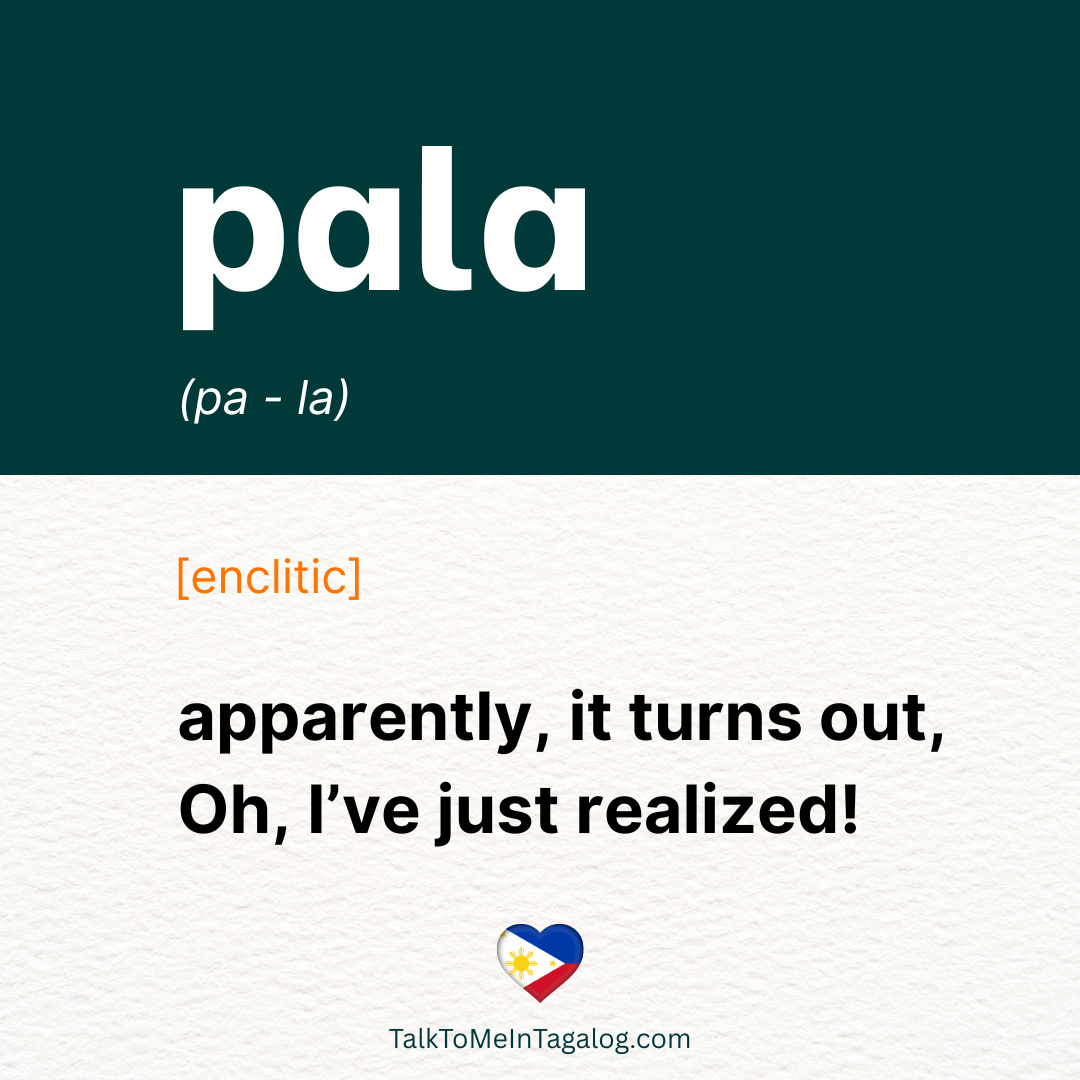
Iniisip ko kung saan galing ang amoy. Nasusunog pala yung niluluto ko. (I was wondering where the smell came from. Turns out I burned the food.)
Umalis ako nang maaga, ‘yun pala hapon pa ang meeting. (I left early, but it turns out the meeting isn’t until this afternoon.)
Sarado pala ang talyer kapag Linggo. (It turns out the workshop is closed on Sundays.)
Inaantay ko siya kanina. Nasa loob na pala siya. (I was waiting for her earlier. Turns out she was already inside.)
Akala ko mamahalin. Ang mura lang pala. (I thought it was expensive. Turns out it’s super cheap.)
Hindi ko alam na birthday niya pala ngayon. (I didn’t know — apparently it’s his birthday today.)
May pasok pala tayo bukas. (Apparently, we have work/class tomorrow.)
Magkaibigan pala sila noon pa. (They’ve apparently been friends for a long time.)
Siya pala ang tumawag sa akin kagabi. (Apparently, he’s the one who called me last night.)
Hindi pala siya marunong lumangoy. maayos. (Apparently, he doesn’t know how to swim.)
Iba pala ang ibig niyang sabihin. (Apparently, he meant something else.)
Magkapatid pala sila? (Oh, they’re siblings?)
Takot ako sa kanya dati pero mabait naman pala siya. (I was scared of him before, but it turns out he’s actually nice.)
Maaga pala silang nagbubukas tuwing Lunes. (Apparently, they open early on Mondays.)
Hindi ko napansin na umuulan. Basa na pala ako. (I didn’t notice it was raining. Turns out I’m already wet.)
Sabi ko bakit wala ka kahapon. May lakad ka pala. (I wondered why you weren’t around yesterday. Turns out you had plans.)
Ilang ulit ko siyang tinawagan. Naka-silent mode pala ang telepono niya. (I called him so many times. Turns out his phone was on silent.)
Hindi niya pala kayang kumain ng maanghang. (Apparently he can’t handle spicy food.)
Sinisi ko ang sarili ko. Hindi ko naman pala kasalanan. (I blamed myself. Turns out it wasn’t even my fault.)
Marunong pala siya magluto. (Oh, he knows how to cook.)
Watch more Tagalog Learning Videos
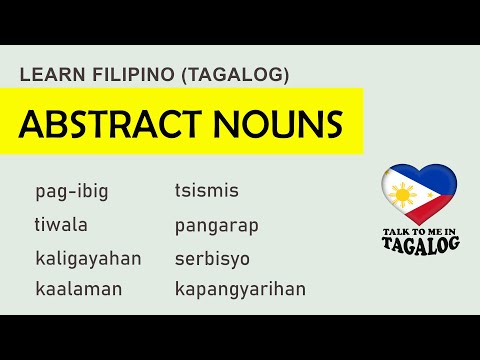
Learn common abstract nouns in Tagalog such as pag-ibig, takot, and kalayaan, and see how they’re used in natural Filipino sentences. This lesson helps learners expand their vocabulary for emotions, ideas, and states, giving you the words you need to express thoughts and feelings clearly in everyday conversation.
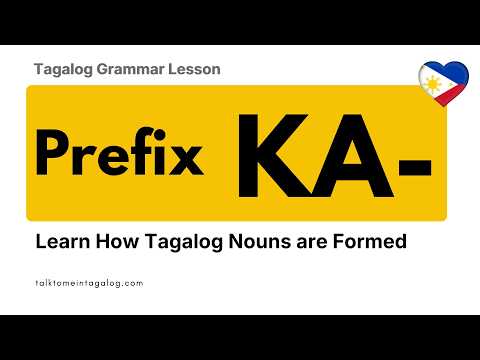
Learn how the KA prefix forms nouns in Tagalog and see how it changes the meaning of words. This lesson explains how the KA prefix works in everyday Filipino, helping you expand your vocabulary and understand how nouns are created and used naturally in conversation.

Learn how Tagalog IN verbs work with real examples showing passive or object-focused actions in natural Filipino sentences. This lesson helps learners understand conjugation, verb focus, and everyday usage, making it easier to speak and write Tagalog accurately.
Connect
Our YouTube Channels
Talk to Me in Tagalog
English-Tagalog Speaking Practice
Learn Filipino Language
OFW English Lessons
Want to support us?