
How to Say "Than" in Tagalog | KAYSA in English
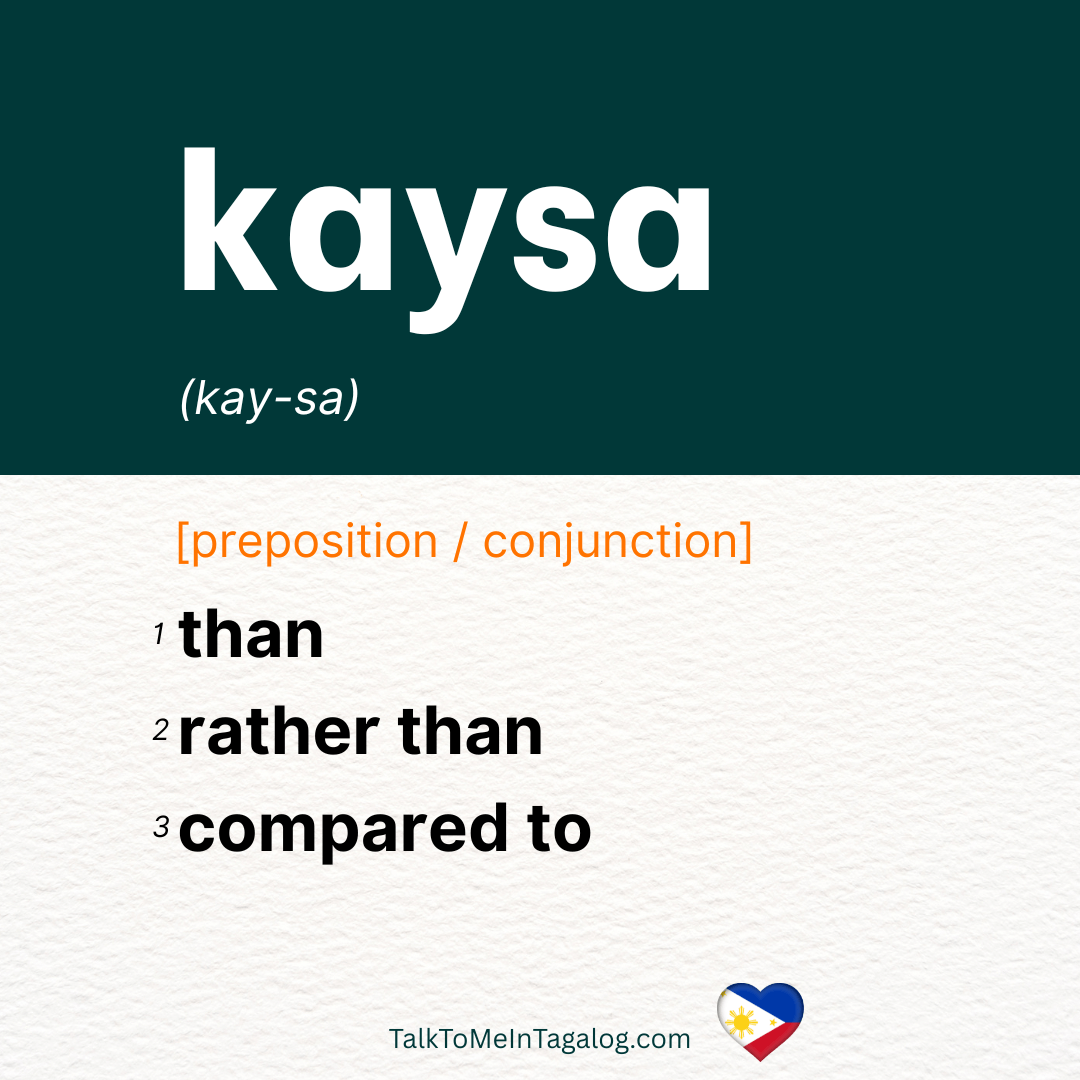
The Tagalog word “kaysa” is used to make comparisons, similar to “than” in English, and it’s the key word for contrasting two things, qualities, or actions. This Filipino lesson for beginners shows how kaysa fits naturally in sentences, with clear examples and English translations so you can see how comparisons work in real Tagalog conversation. Learning kaysa helps you describe preferences, highlight differences, and speak more clearly and confidently when comparing ideas in everyday dialogue.
Mas mabilis akong mag-type kaysa sa kanya. (I type faster than her.)
Mas maganda ang dagat sa Boracay kaysa sa Batangas. (The sea in Boracay is nicer than in Batangas.)
Mas importante ang kalusugan kaysa kayamanan. (Health is more important than wealth.)
Mas madaling sabihin kaysa gawin. (That’s easier said than done.)
Mas masaya ako ngayon kaysa noon. (As long as it’s not against the law.)
Mas gusto ko ang malamig na panahon kaysa mainit. (I prefer cold weather over hot weather.)
Mas maayos ang kuwarto ko kaysa sa kuwarto ng kuya ko. (My room is tidier than my brother’s room.)
Mas mahilig ako sa matamis kaysa maasim. (I like sweet foods more than sour ones.)
Mas magaling siya magluto kaysa sa akin. (She is a better cook than I am.)
Mas gusto ko ang lutong-bahay kaysa fast food. (I prefer home-cooked meals over fast food.)
Mas magaan ang pakiramdam ko ngayon kaysa kahapon. (I feel better now than I did yesterday.)
Mas gusto ko pang magbasa ng libro kaysa manood ng TV. (I’d rather read a book than watch TV.)
Mas gusto ko ang mga lumang kanta kaysa sa mga bago. (I like old songs more than the new ones.)
Mas mabilis siya tumakbo kaysa sa akin. (He runs faster than I do.)
Mas gusto kong magtrabaho kaysa tumambay. (I’d rather work than hang out.)
Mas malaki ang bahay nila kaysa sa amin. (Their house is bigger than ours.)
Featured Filipino Word
Mas gusto ko ang kape kaysa sa tsaa. (I prefer coffee over tea.)
Mas matangkad ako kaysa sa iyo. (I’m taller than you.)
Mas nakakatawa siya kaysa sa komedyante. (He’s funnier than a comedian.)
Mas magaling ka rito kaysa sa akin. (You’re better at this than I am.)
Mas masama ang panahon ngayon kaysa kahapon. (The weather today is worse than yesterday.)
Mas komportable ang upuang ‘yon kaysa dito. (That chair is more comfortable than this one.)
Mas okay na ‘yan kaysa wala. (It’s better than nothing.)
Mas makatotohanan ang planong ito kaysa ‘yung sa iyo. (This plan is more realistic than yours.)
Mas palakaibigan siya kaysa kay Emma. (She’s friendlier than Emma.)
Mas magaling kang kumanta kaysa kay Joanne. (You sing better than Joanne.)
Mas komportable ako sa’yo kaysa sa kanila. (I’m more comfortable with you than with them.)
Mas malapit ako sa kanya kaysa sa sarili kong kapatid. (I’m closer to her than to my own sister.)
Mas magaan ang kahong ito kaysa sa isa. (This laptop is lighter than the other one.)
Mas gusto kong tumawag kaysa mag-text. (I’d rather call than text.)
Mas gugustuhin kong matalo kaysa mandaya. (I’d rather lose than cheat.)
Mas malala ito kaysa sa inaakala ko. (This is worse than I thought.)
Mas matagal na akong naghihintay kaysa sa iyo. (I’ve been waiting longer than you.)
Mas gusto ko ang aso kaysa sa pusa. (I like dogs more than cats.)
Mas masipag ka kaysa sa akin. (You’re more hardworking than me.)
Mukhang mas mahal ang bag mo kaysa sa akin. (Your bag looks more expensive than mine.)
Mas may tiwala ako sa iyo kaysa sa kanya. (I trust you more than him.)
Mas gusto kong kumain sa bahay kaysa sa labas. (I’d rather eat at home than dine out.)
Mas mura ang kamisetang ito kaysa diyan. (This shirt is cheaper than that one.)
Mas gusto kong matulog nang maaga kaysa magpuyat. (I prefer sleeping early over staying up late.)
Mas gusto kong magbisikleta kaysa maglakad. (I prefer biking to walking.)
Mas matalino siya kaysa sa mga pinsan ko. (He’s smarter than my cousins.)
Mas masarap ang pagkain dito kaysa sa restawran doon sa kanto. (The food here is better than at the restaurant on the corner.)
Mas mahirap ang exam ngayon kaysa noong nakaraang linggo. (Today’s exam is harder than last week’s.)
Mas mura ang mga bilihin sa palengke kaysa sa mall. (Prices at the market are cheaper than in the mall.)
Mas magaan ang buhay sa probinsya kaysa sa siyudad. (Life in the province is easier than in the city.)
Mas mahirap magbasa ng maliliit na font kaysa malalaki. (It’s harder to read small fonts than big ones.)
Mas lubak-lubak ang mga kalsadang rito kaysa doon sa kabilang barangay. (The roads here are bumpier than those in the other barangay.)
Watch more Tagalog Learning Videos
Need to say “similar” or “the same” in Tagalog? Learn the right Filipino words to express likeness, comparison, or identical things in natural sentences.
Want to say “possible” or “can” in Tagalog? Learn how to use “puwede” to express permission, possibility, or ability in everyday Filipino conversation.
Wondering how to say “used to” in Tagalog? Learn how “sanay” is used to express familiarity, habit, or past comfort in natural Filipino.
Connect
Our YouTube Channels
Talk to Me in Tagalog
English-Tagalog Speaking Practice
Learn Filipino Language
OFW English Lessons
Want to support us?