
How to Tell Time in Tagalog
Learning how to tell the time in Tagalog is essential for daily conversations, scheduling appointments, and understanding Filipino time expressions. This guide explains how to say hours, minutes, and periods of the day, including common phrases like “alas siyete ng umaga” (7:00 AM) and “alas tres ng hapon” (3:00 PM). You’ll also find practical examples for asking and telling time in real-life situations, whether you’re traveling, attending meetings, or coordinating with friends and family.
How to Tell Time in Filipino: Watch this Tagalog Lesson for Beginners
Although native cardinal numbers exist for telling time, the Spanish-derived system is more commonly used in everyday Tagalog, like ‘alas otso diyes ng umaga,’ (8:10AM) or even mixed with English. Learning the native form is still important to understand traditional expressions, formal contexts, and fully grasp the language.
Tagalog Guide to Telling Time
Ready to test how accurately you can tell time in Filipino? Take the short quiz below and see how you do.
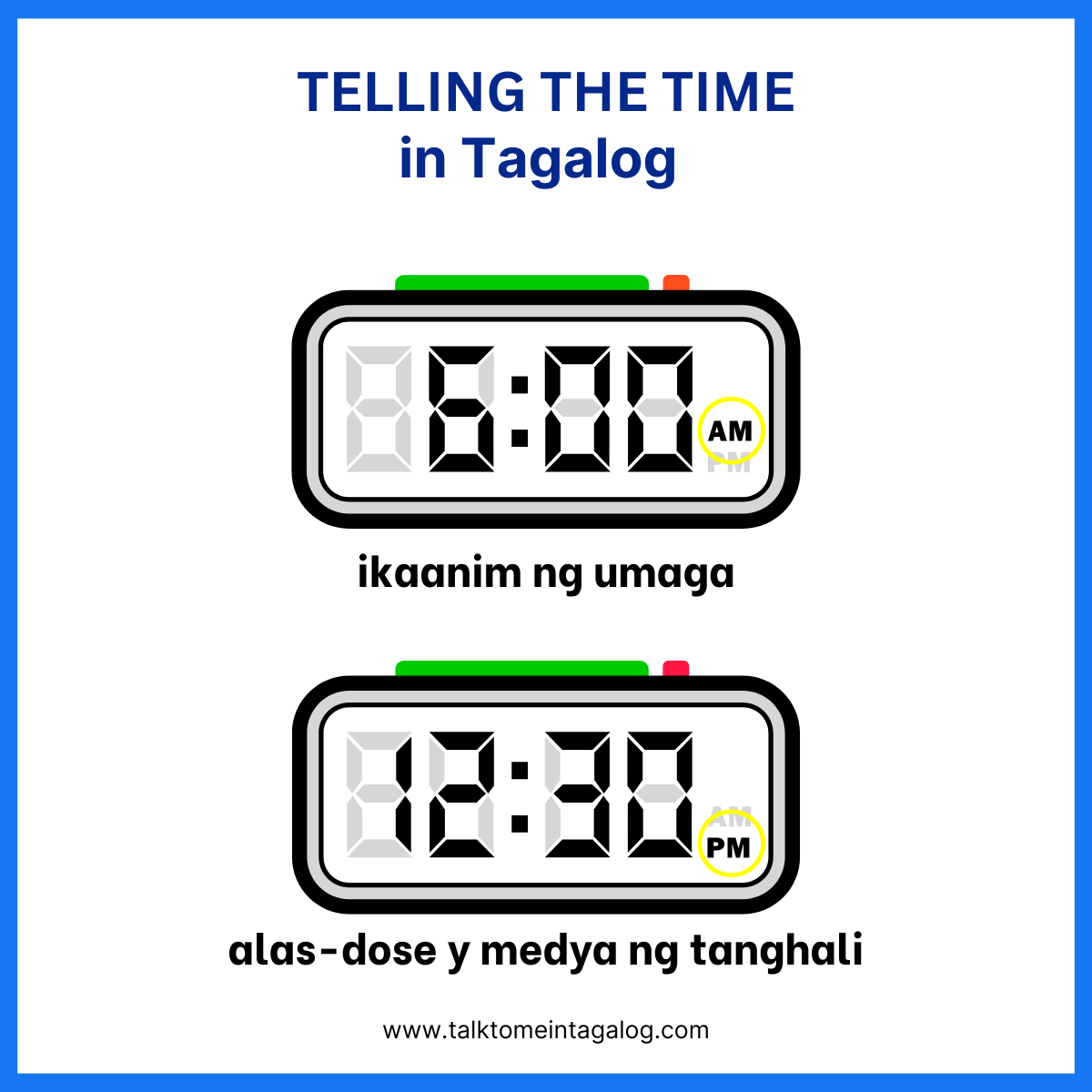
Grammar Tip:
To say the time with minutes using native Tagalog cardinal numbers, use this pattern:
Examples:
8:10AM → Ikawalo at sampu ng umaga
10:26AM → Ikasampu at dalawampu’t anim ng umaga
12:00PM → Ikalabindalawa ng tanghali (without minutes)
2:33PM → Ikadalawa at tatlumpu’t tatlo ng hapon
6:40PM → Ikaanim at apatnapu ng gabi
To indicate ‘half past the hour,’ place ‘at kalahati’ after the hour; it means ‘half’ or 30 minutes past the hour.
12:30PM → Ikalabindalawa at kalahati ng tanghali
11:30PM → Ikalabing-isa at kalahati ng gabi
As mentioned earlier, Spanish-influenced cardinal numbers are the ones Filipinos actually use when telling time. You’ll hear them constantly in daily conversations – sometimes even mixed with English numbers.
This mix comes from centuries of Spanish influence on the language, and today it’s so deeply embedded in everyday speech that many Filipinos don’t even think of it as “Spanish” anymore, it’s simply the most natural way to say the time.
Grammar Tip:
To say the time with minutes in Tagalog using Spanish-influenced numbers, use this pattern:
Alas~ is a prefix for telling time, used for all hours except 1 o’clock which uses Ala~;
Examples:
6:15AM → Alas-sais kinse ng umaga
7:23AM → Alas-syete bente tres ng umaga
1:40PM → Ala-una kuwarenta ng hapon
9:00PM → Alas-nuwebe ng gabi (without minutes)
To say ‘half past the hour,’ use the connecting word y, pronounced ‘ee,’ before medya, which means ‘half’ or 30 minutes past the hour.
Examples:
8:30AM → Alas-otso y medya ng umaga
1:30PM → Ala-una y medya ng hapon
11:30PM → Alas-onse y medya ng gabi
12:30AM → Alas-dose y medya ng madaling-araw

| Gigising ako ng alas-sais ng umaga. |
| (I’ll wake up at 6 in the morning.) |
| Kakain kami ng tanghalian sa alas-dose ng tanghali. |
| (We’ll eat lunch at 12 noon.) |
| Dumating siya ng alas-tres bente ng hapon. |
| (She arrived at 3:20 in the afternoon.) |
| Aalis kami ng bahay ng alas-siyete kinse ng gabi. |
| (We’re leaving the house at 7:15 tonight.) |
| Matutulog na ako ng alas-diyes kuwarenta y singko ng gabi. |
| (I’ll go to bed at 10:45 tonight.) |
| Nasa bahay na kami ng alas-dose ng hatinggabi. |
| (We’re already home by 12 midnight.) |
| Nagising ako ng alas-kuwatro singkuwenta y singko ng madaling-araw. |
| (I woke up at 4:45 in the morning.) |
Can you tell the time in Tagalog? Put your skills to the test with this fun quiz! Try to say the correct Tagalog time before clicking the toggle to reveal the answer. Whether it’s morning, noon, or night, this quiz will help you get more comfortable with telling time in Filipino!
1. What do you call the time when it’s exactly 12:00 midnight?
Answer: alas-dose ng hatinggabi or ika-labindalawa ng hatinggabi
2. What is the Tagalog word for 1:30 in the afternoon?
Answer: ala-una y medya ng hapon or ikaisa’t kalahati ng hapon
3. How do you say 7:15AM in Tagalog?
Answer: alas-siyete kinse ng umaga or ikapito at labinlima ng umaga
4. How do you say 3:20PM in Filipino?
Answer: alas-tres bente ng hapon or ikatatlo’t dalawampu ng hapon
5. What is the Tagalog word for 8 o'clock in the evening?
Answer: alas-otso ng gabi or ikawalo ng gabi
Watch more Tagalog Learning Videos
Watch this video to learn the essential Tagalog words for the time of day, with clear examples you can start using right away. This lesson covers the most common Filipino terms you’ll hear in real conversations, making it perfect for beginners and travelers.
Watch this video to learn how to count in Filipino with clear pronunciation and easy-to-follow examples. This basic Filipino lesson walks you through the essential Tagalog numbers you’ll hear in everyday conversations.
Watch this video to learn the key Tagalog terms for units of measurement used in everyday Filipino conversations. You’ll hear how these words naturally show up in real-life contexts like cooking, shopping, and daily tasks.
Connect
Our YouTube Channels
Talk to Me in Tagalog
English-Tagalog Speaking Practice
Learn Filipino Language
OFW English Lessons
Want to support us?