
KAY - Learn How to Say "To" or "For" in Tagalog
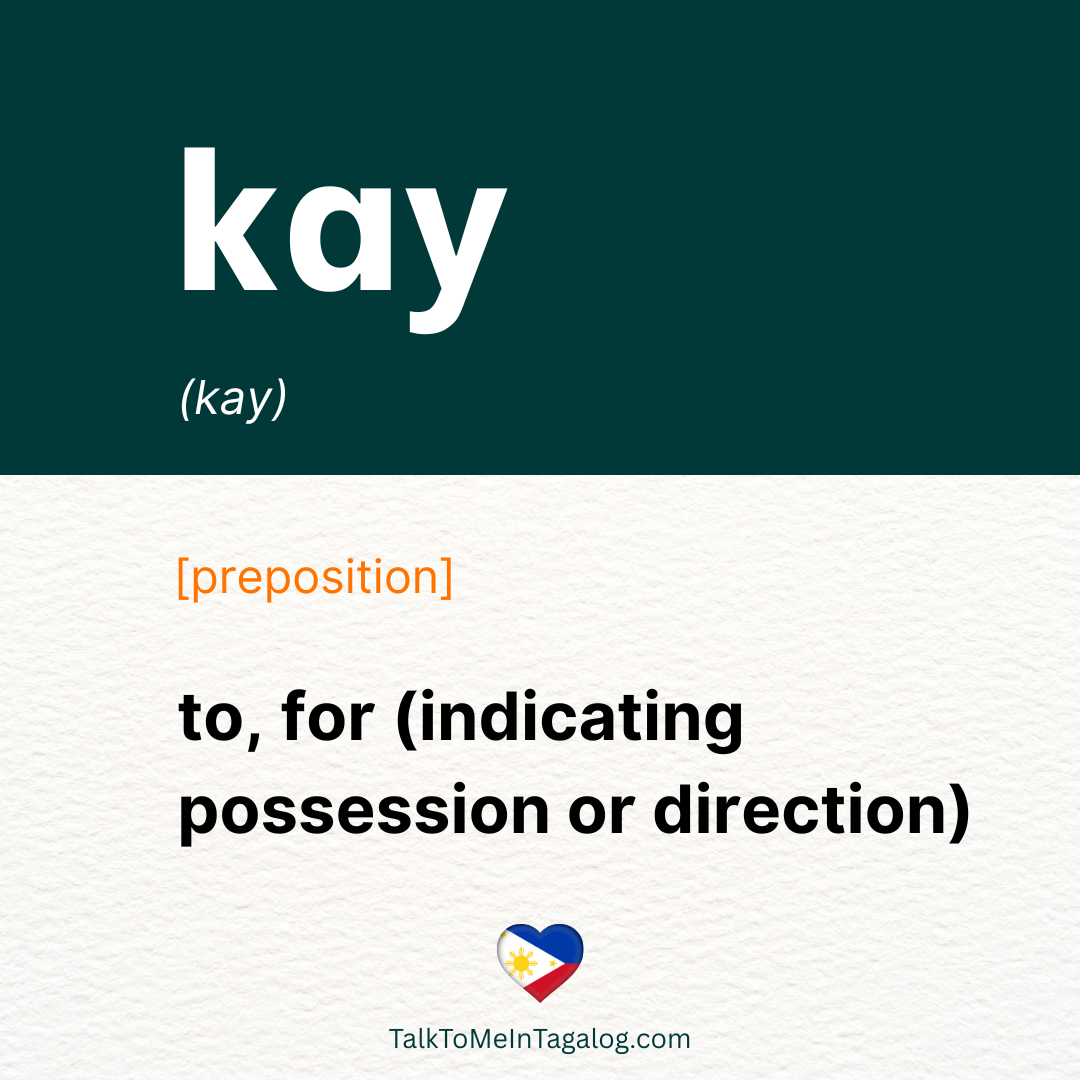
Looking for the Tagalog word to say something is for someone or a person? In Filipino, the word you need is “Kay.” This important Tagalog particle is used to indicate direction to someone, show possession belonging to someone, or make a direct reference to a person. In this basic Tagalog lesson for beginners, you’ll learn how to use Kay with singular proper nouns or personal names, with practical sentence examples and clear English translations. Understand this crucial Filipino grammar lesson and start speaking Tagalog naturally and correctly today!
→ Indicating Direction/Recipient (To/For someone)
Ibibigay ko ito kay Raizen. (I’ll give this to Raizen.)
Para kay Roger ang regalo. (The gift is for Roger.)
Magpadala ka ng lumpiang sariwa kay Jake. (Send some fresh spring rolls to Jake.)
Ibalik mo kay Paul ang bayad. (Give the payment back to Paul.)
Kunin mo kay Wessam ang abrealata. (Get the can opener from Wessam.)
Bumili ako ng puto at kutsinta para kay Jennifer. (I bought some rice cakes for Jennifer.)
Sabihin mo kay Sandy na pupunta ako. (Tell Sandy that I’m coming.)
Ipaliwanag mo kay Nanay kung ano talaga ang nangyari. (Explain to Nanay what really happened.)
Dadalhin ko kay Zamantha ang mga resibo. (I’ll bring the receipts to Zamantha.)
Nagbigay siya ng bulaklak kay Anish. (He gave flowers to Anish.)
Featured Filipino Word
→ Indicating Possession (Of/Belonging to someone):
Na kay Percy ang susi. (The key is with Percy.)
Kay Mark ang mga gamit na ‘to. (These things belong to Mark. / These are Mark’s stuff.)
Kay Lolo ang mga kabayong iyon. (Those horses belong to Grandpa.)
Na kay Cecil ba ang sangkalan natin? (Is our chopping board with Cecil?)
Wala ba kay Richard ang lagari natin? (Isn’t our saw with Richard? / Doesn’t Richard have our saw?)
Kay Gerry ba ang gitarang ‘yan? (Is that guitar Gerry’s?)
Na kay Pangulong BongBong Marcos ang desisyon. (The decision is with President BongBong Marcos.)
Wala kay Ben ang charger mo. Na kay Izaque. (Your charger is not with Ben. It’s with Izaque.)
→ In Comparisons (Than someone):
Mas matangkad si Alex kaysa kay David. (Alex is taller than David.)
Mas magaling lumangoy si Liza kaysa kay Kim. (Liza is better at swimming than Kim.)
Mas bata si Lilith kaysa kay Rachel. (Lilith is younger than Rachel.)
Mas tahimik si Maria kaysa kay Daniel. (Maria is quieter than Daniel.)
Mas magaling mag-chess si Carlo kaysa kay Leo. (Carlo is better at chess than Leo.)
Mas matalino si Rizal kaysa kay Andres. (Rizal is smarter than Andres.)
Mas maganda si Genevieve kaysa kay Fiona. (Genevieve is prettier than Fiona.)
→ Source of Information (According to/From Someone/About):
Ayon kay Doc Eric, mahala ang pagkain ng prutas araw-araw. (According to Doc Eric, eating fruits every day is important.)
Ayon kay Mayor, aayusin na ang lumang tulay. (According to the Mayor, the old bridge will be fixed.)
Tungkol kay Elon Musk ang balita. (The news is about Elon Musk.)
Narinig ko ang tsismis kay Aling Nena. (I heard the gossip from Aling Nena.)
Humingi kami ng tulong kay Kapitan. (We asked for help from the Captain.)
May tanong si Jess kay Prof. Murad. (Jess has a question for Professor Murad.)
Galing kay Donna ang ideyang ‘yon. (That idea came from Donna.)
→ Expressing Intensity/Amazement (How + adjective) – Poetic:
Kay bilis talaga ng panahon! (How fast time really flies!)
Kay haba naman ng pila! (How long the line is!)
Kay tamis ng manggang ito! (How sweet this mango is!)
Kay pait naman ng kapeng ito! (How bitter the coffee is.)
Kay ganda ng tanawin dito! (How beautiful the view is!)
Watch more Tagalog Learning Videos
Need to know how to say “for” in Tagalog? Learn the different Filipino words like “para sa” and how to use them naturally when talking about purpose, recipients, or intentions.
Does Tagalog have a word for “the”? Discover how Filipino handles definite articles without a direct equivalent, and learn how meaning is shown through context and sentence structure.
Curious about “si” and “sina” in Tagalog? Learn how these Filipino markers are used to indicate proper nouns like names in both singular and plural forms.
Connect
Our YouTube Channels
Talk to Me in Tagalog
English-Tagalog Speaking Practice
Learn Filipino Language
OFW English Lessons
Want to support us?