
How to Say "All" in Tagalog | LAHAT in English
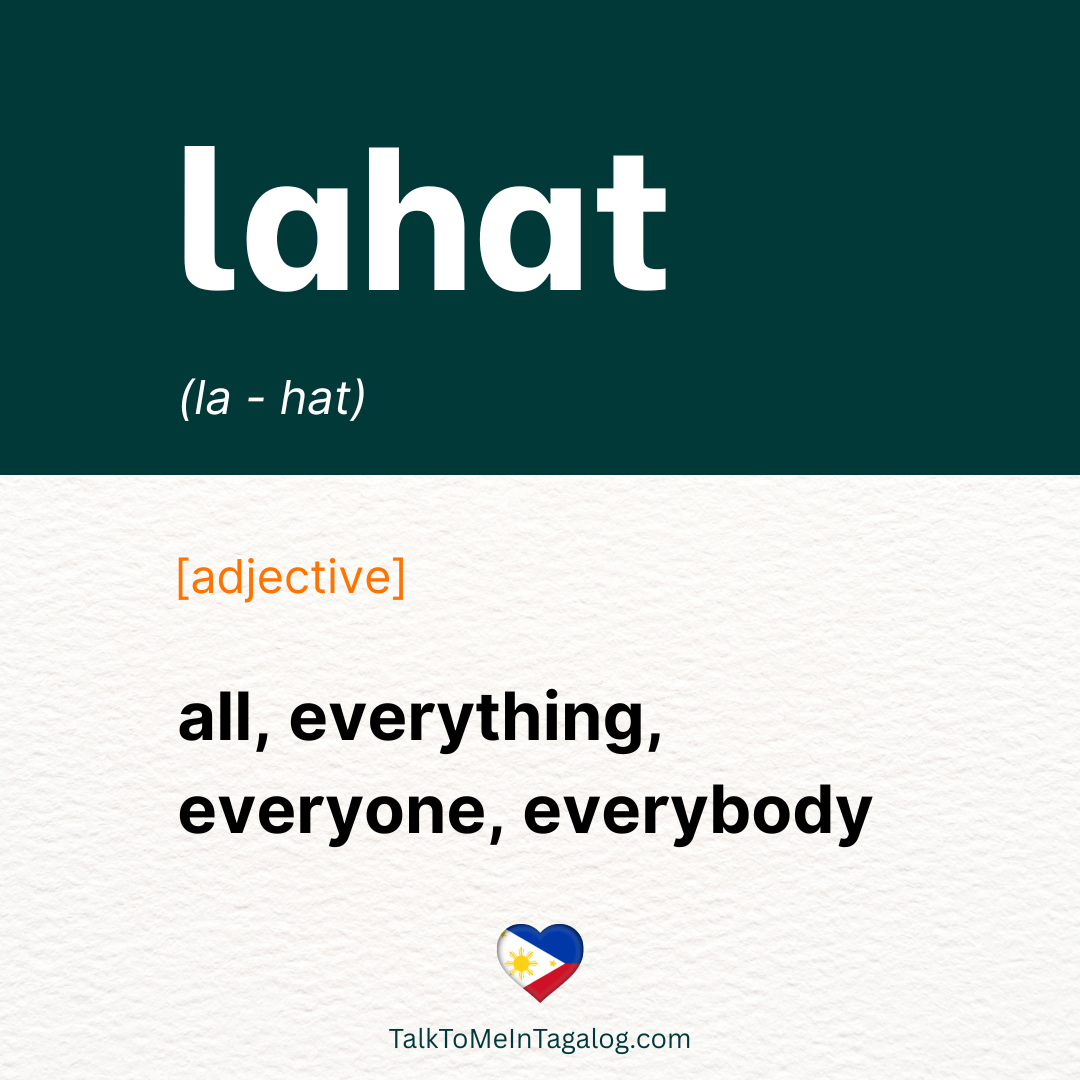
How do you say “all” or “everything” in Tagalog? This lesson breaks down lahat, the key Filipino word used when referring to an entire group, a complete set, or the whole of something. You’ll see how lahat appears in everyday Tagalog through practical sentence examples paired with clear English translations, helping you understand its meaning and use it naturally. Learn how to apply lahat in different real-life situations, from talking about everyone in a room to referring to everything you own so you can speak Filipino with greater clarity, accuracy, and confidence.
→ As “ALL”
Sariwa ang lahat ng gulay sa palengke. (All the vegetables at the market are fresh.)
Nandito ang lahat ng gamit mo. (All your things are here.)
Masaya ang lahat ng mga bata sa party. (All the kids are having fun at the party.)
Bukas ang lahat ng bintana sa kuwarto. (All the windows in the room are open.)
Okupado ang lahat ng upuan. (All the seats are taken.)
Masarap ang lahat ng pagkain sa handaan. (All the food at the party was delicious.)
Naghihintay na silang lahat sa labas. (They’re all waiting outside now.s.)
Nag-overtime ang lahat ng staff. (All the staff worked overtime.)
Binati niya kaming lahat. (He greeted all of us.)
Nabenta na ang lahat ng tiket. (All the tickets are sold out.)
Featured Filipino Word
→ As “EVERYTHING”
Narinig niya ba lahat? (Did she hear everything?)
Itinapon ko na lahat sa basurahan. (I threw everything in the trash.)
Nasira lahat dahil sa baha. (Everything was ruined because of the flood.)
Inilagay ko lahat sa supot. (I put everything in the bag.)
Ibinigay ko na sa kanya lahat ng kailangan niya. (I already gave her everything she needs.)
Nakalimutan mo na ba ang lahat ng sinabi niya sa iyo? (Have you forgotten everything he told you?)
Ipinaliwanag mo ba sa kanila lahat? (Did you explain everything to them?)
Kinuha niya lahat ng nasa mesa. (He took everything that was on the table.)
Nilinis niya ang lahat bago umalis. (She cleaned everything before leaving.)
Binili niya lahat kahit na mahal. (He bought everything even though it was expensive.)
Ibinalik namin ang lahat sa dati. (We put everything back the way it was.)
Naempake ko na lahat. (I’ve already packed everything.)
→ As “EVERYONE” or “EVERYBODY”
Umalis na lahat ng tao. (Everyone has left.)
Hinahangaan siya ng lahat ng tao. (Everybody looks up to him.)
Tahimik ang lahat sa meeting kanina. (Everyone was quiet during the meeting earlier.)
Pumayag ang lahat sa gusto niyang mangyari. (Everyone agreed to what he wanted.)
Lahat ng tao ay may kanya-kanyang kwento. (Everyone has their own story.)
Gusto siya ng lahat ng tao sa kumpanya namin. (Everyone in our company likes him.)
Alam ng lahat ang totoo. (Everybody knows the truth.)
Nandito na ba ang lahat? (Is everyone here now?)
Tawagin mo na silang lahat. (Call everyone now.)
Kilala niya ang lahat ng tao sa bayan. (He knows everyone in town.)
Hindi lahat sa Pilipinas ay may sariling sasakyan. (Not everyone in the Philippines has their own car.)
Watch more Tagalog Learning Videos
Explore gender-neutral Tagalog words used in Filipino conversations—covering terms for people, roles, and professions without gender bias. Learn how Filipino handles inclusivity through natural sentence examples.
Learn how to say “if” in Tagalog using the word “kung.” See how it’s used in conditional sentences, questions, and everyday Filipino speech.
Connect
Our YouTube Channels
Talk to Me in Tagalog
English-Tagalog Speaking Practice
Learn Filipino Language
OFW English Lessons
Want to support us?