
How to Say "For" in Tagalog | PARA KAY in English
If you want to say “for [someone]” in Tagalog, the phrase “para kay” is what you’ll use. It’s how Filipinos show that something like a gift, a message, or an action, is meant for a specific person. This Filipino lesson walks you through real-life examples with accurate English translations, so you can see exactly how “para kay” fits naturally into conversation. Learning it will make it easier to express intentions, dedicate things properly, and speak Tagalog in a way that sounds authentic and confident.
How to Say FOR (Someone) in Filipino: Watch this easy Tagalog Lesson for Beginners
Para kay Yuning ang regalong ito. (This gift is for Yuning.)
Bumili ako ng kuwintas para kay Megan. (I bought a necklace for Megan.)
Nagluto ako ng sopas para kay Lola. (I cooked macaroni soup for Grandma.)
Para kay Tom ba ang sulat na ‘to? (Is this letter for Tom?)
Para kay Weng ang mga prutas na ito. (These fruits are for Weng.)
Nakareserba ang upuang ‘yan para kay Bongbong. (That seat is reserved for Bongbong.)
Naghahanda kami ng party para kay Althea. (We’re organizing a party for Althea.)
Mag-bake tayo ng cake para kay Vivian. (Let’s bake a cake for Vivian.)
May dala akong guyabano at saka kaimito para kay Melissa. (I brought some soursop and star apple for Melissa.)
Featured Filipino Word
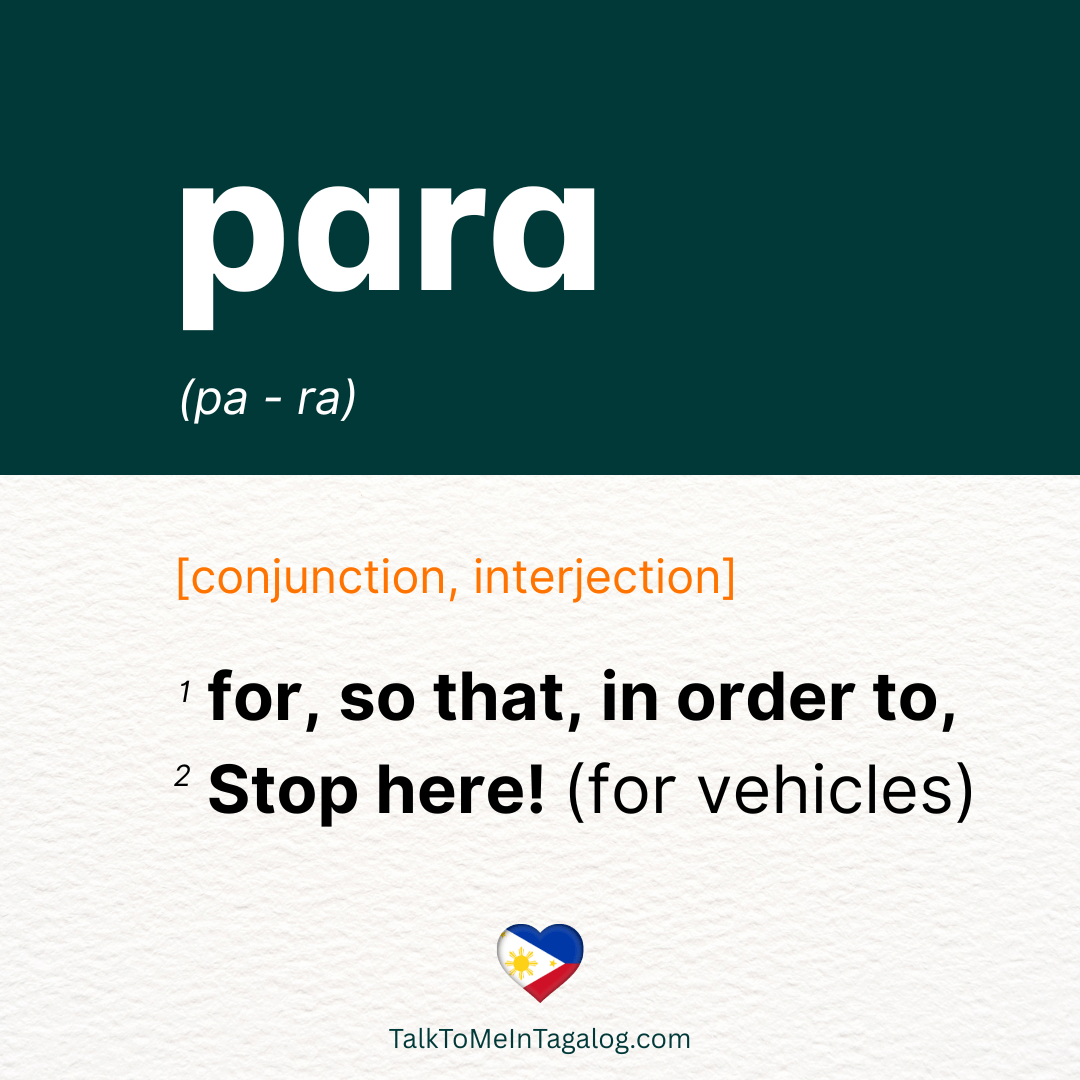
Mag-abang ka nga ng taxi para kay Franz. (Wait outside and flag a cab for Franz.)
Itabi mo ‘yan para kay Nena. (Save that for Nena.)
Para kay Mang Roger ang bayad. (The payment is for Mang Roger.)
May package dito para kay Rachel. (There’s a package here for Rachel.)
Nag-iipon ako ng mga barya para kay Tom. (I’m saving up coins for Tom.)
Nagpatahi ako ng bestida para kay Macey. (I had a dress made for Macey.)
Nagpagawa ako ng keychain para kay Emma. (I had a keychain made for Emma.)
Para kay Mimi ang asul na tasa. (The blue mug is for Mimi.)
Para kay Hillary ang malaking bag. (The big bag is for Hillary.)
Para kay Catherine ang mga gamit na nasa kahon. (The things in the box are for Catherine.)
May iniwang pera si Mama para kay Ate. (Mom left money for Ate.)
Nag-order kami ng mga lobo para kay Antonietta. (We ordered balloons for Antonietta.)
→ Use ‘PARA KINA’ for two or more people
Para kina Andrea at Flor ang mga tsokolateng nasa supot. (The chocolates in the bag are for Andrea and Flor.)
Para kina Myla at Emily ang mga damit pang-swimming. (The swimsuits are for Myla and Emily.)
May nagpadala ng bulaklak para kina Alice at Trixie. (Someone sent flowers for Alice and Trixie.)
Para kina Art at Jake ang mga bagong headset. (The new headsets are for Art and Jake.)
May pasalubong akong daing at tuyo galing Cebu para kina Ben at Lydia. (I brought dried fish as gifts from Cebu for Ben and Lydia.)
Magpagawa tayo ng duyan para kina Amy at Rufina. (Let’s have a hammock made for Amy and Rufina.)
Magtimpla ka nga ng kape para kina Edgar at Caloy. (Please make some coffee for Edgar and Caloy.)
Watch more Tagalog Learning Videos
Learn how to use si and sina in Tagalog to refer to people in everyday sentences. If you’ve wondered when to use si versus sina or want to understand how Filipino subject markers work, this lesson makes it simple and practical.
Learn how to use the Tagalog pronoun kita to say “I [do something] to you” in everyday Filipino sentences. If you want to understand how kita works or get comfortable with common Filipino pronoun shortcuts in conversation, this lesson breaks it down clearly and practically.
Learn how to say “should” in Tagalog using the word dapat through real Filipino sentences that show obligation or give advice. If you want to see how dapat works in everyday conversation or get a handle on Filipino modal verbs, this lesson makes it simple and practical.
Connect
Our YouTube Channels
Talk to Me in Tagalog
English-Tagalog Speaking Practice
Learn Filipino Language
OFW English Lessons
Want to support us?