
How to Say Already in Tagalog | NA in English
Learn how to say ‘already’ in Tagalog to indicate a completed action or a change of state. This essential Filipino lesson for beginners explores ‘na,’ a common Tagalog particle used to express completion, immediacy, or a shift in condition. You’ll fully understand its meaning and discover how to use ‘na’ naturally in everyday sentences. This tutorial includes useful Tagalog phrases with easy-to-understand English translations, this lesson helps you grasp its grammar and everyday usage with ease.
How to Say ALREADY in Filipino: Watch this Tagalog Lesson for Beginners
→ Na as Already (Action Completed)
Nasa bahay na ako. (I’m home already.)
Umalis na siya. (He already left.)
Sarado na ang tindahan. (The store is already closed.)
Dumating na ang bus. (The bus already arrived.)
Nakapunta na ako roon. (I’ve already been there.)
Nilinis na niya ang kuwarto. (She already cleaned the room.)
Bumili na ako ng bagong sapatos. (I already bought new shoes.)
Naibenta na ang lupa. (The land has already been sold.)
Nagbayad na ako. (I already paid.)
Nabasa ko na ito. (I already read this.)
Nakuha na niya. (He already got it.)
Nailabas ko na ang basura. (I already took out the trash.)
Featured Filipino Word
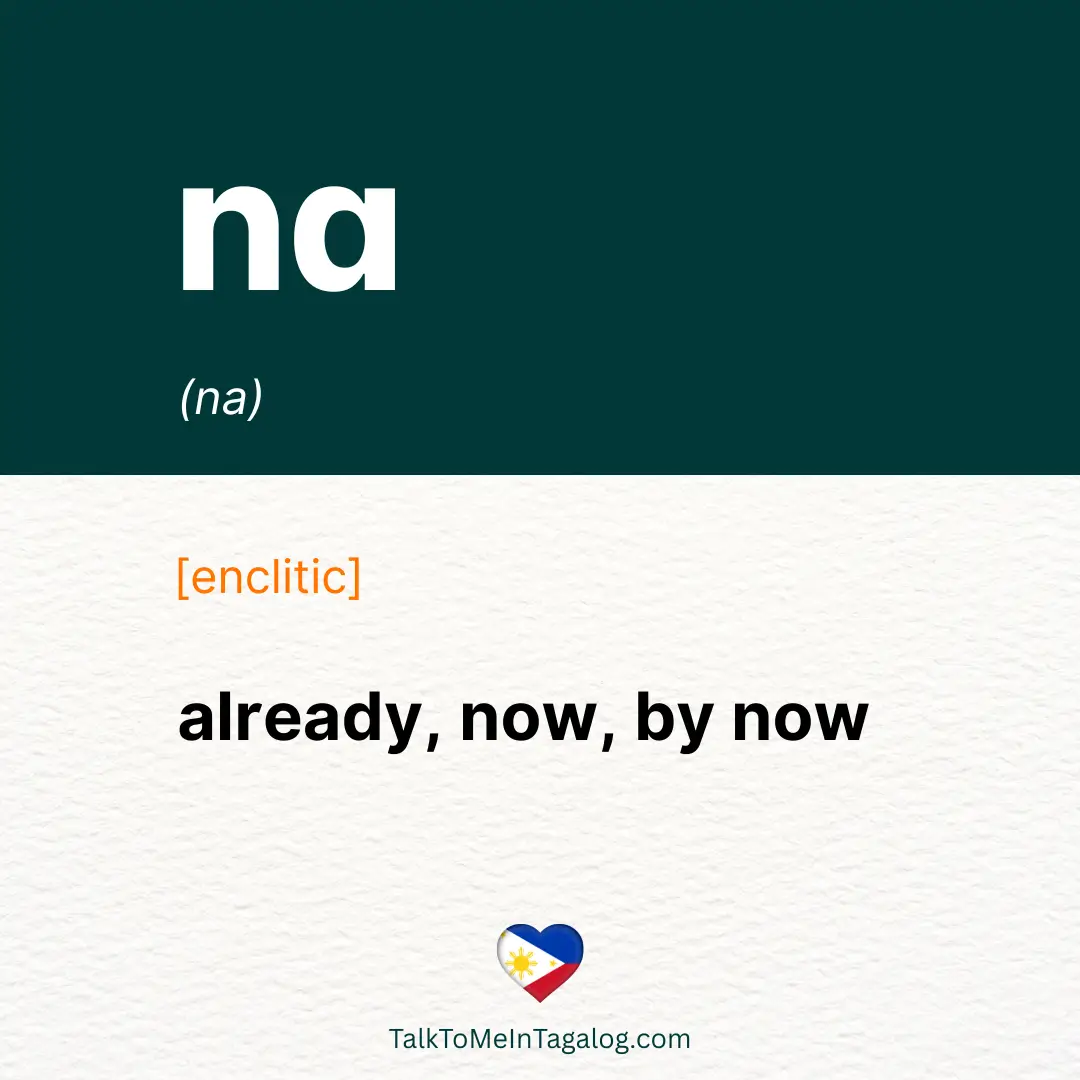
→ NA as Now, Already and Become (Change of State)
Malaki na ang anak ko. (My son is all grown up now.)
May asawa na siya. (He’s already married.)
Matanda na ang lolo ko. (My grandfather is old now.)
Madilim na sa labas. (It’s already dark outside.)
Malamig na ang panahon. (The weather is already cold.)
Gising na ang bata. (The baby is awake now.)
Kalbo na siya. (He’s bald now.)
Ang haba na ng pila. (The line is long already.)
Malabo na ang mata ko. (My eyes are blurry now.)
Patay na si Shrek. (Shrek is dead now. / Shrek has died.)
Magaling na ako. (I’m feeling better now.)
Puno na ang paradahan. (The parking lot is full now.)
Hinog na ang mangga. (The mango is ripe now. / The mango has ripened.)
Kumpleto na ang grupo. (The group is complete now.)
Sira na ang sapatos mo. (Your shoes are beat up.)
Malala na ang sakit niya. (Her illness is serious now. / Her condition has gotten worse.)
Marami na siyang kakilala sa lugar na iyon. (She knows a lot of people in that area now.)
Puti na ang buhok ni Aling Salome. (Aling Salome’s hair is white now.)
Watch more Tagalog Learning Videos

Learn how to say “it turns out” in Tagalog using “pala” to express surprise or realization. This video explaians how “pala” adds emotion and context in natural Filipino sentences. Watch now to speak Tagalog more fluently and with confidence!

Learn how to say “or” in Tagalog using “o” for making choices and comparisons. This video shows how “o” is used naturally in Filipino sentences for everyday conversations. Watch now to improve your Tagalog grammar and sound more fluent!

Learn the Tagalog “mag-” verb conjugation rules with clear explanations and real-life examples. This video covers how to conjugate mag-verbs in past, present, and future tenses for everyday Filipino. Watch now to master “mag-” verbs and speak Tagalog more naturally!
Connect
Our YouTube Channels
Talk to Me in Tagalog
English-Tagalog Speaking Practice
Learn Filipino Language
OFW English Lessons
Want to support us?