
NGA - Meaning in Tagalog with Example Sentences
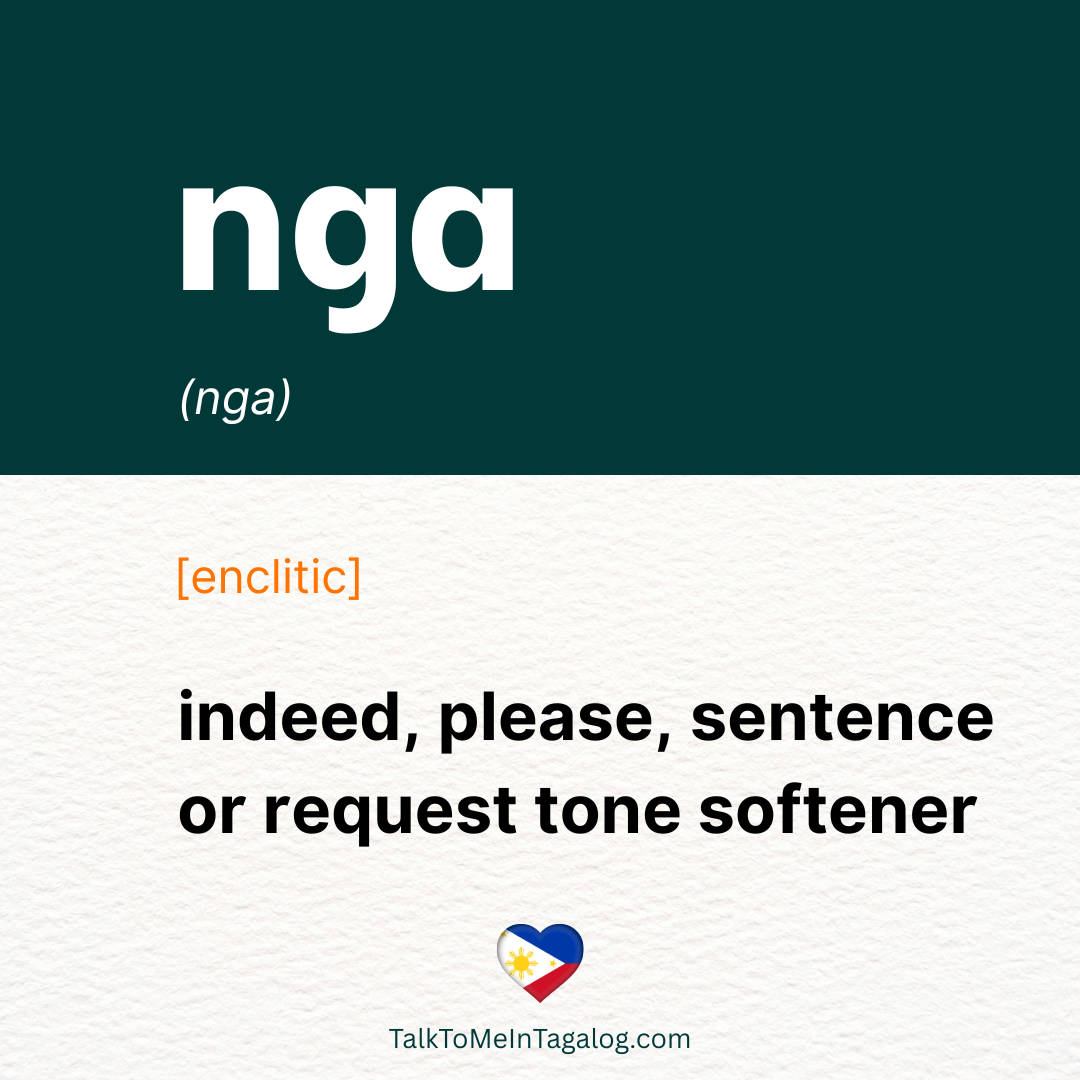
How do you say “indeed,” “really,” or effectively add emphasis in Tagalog? This Filipino language guide explores “Nga,” the powerful yet subtle Tagalog particle used by native speakers to confirm, agree, or stress a point in conversation. You’ll learn its actual meaning and master precisely how Filipinos use ‘Nga’ in real-life examples to add nuance and conviction to their statements. Complete with clear English translations, this lesson helps you understand its subtle meaning and integrate it naturally.
What Does the Tagalog Word NGA Mean? Watch this Filipino Language Lesson for Beginners
→ As Confirmation or Agreement
Oo nga. (Yeah, you’re right.)
Tama nga ang sinabi niya. (What he said was actually right.)
Totoo nga ‘yung tsismis. (So the rumor was true after all.)
May bayad nga pala ‘to. (Oh by the way, there is a fee for this.)
Siya nga ang nanalo sa paligsahan. (He really did win the contest.)
Ganoon nga ang nangyari. (That’s exactly what happened.)
Maganda nga ang tanawin doon. (The view there really is beautiful.)
Kapatid nga niya si Camryn. (Camryn really is his sister.)
Masarap nga itong bibingka nila. (Their bibingka is really good.)
Featured Filipino Word
→ As a Polite Request or Suggestion
Pakikuha mo nga akong baso. (Could you please get me a glass?)
Punasan mo nga ‘yang pawis mo. (Wipe off your sweat.)
Pakiabot nga ng gunting. (Please pass me the scissors.)
Tawagin mo nga si Johara. (Can you call Johara, please?)
Pakibukas nga ng bintana. (Please open the window.)
Pakiayos nga ang kama. (Could you fix the bed, please?)
Pakipatay nga ang ilaw sa labas. (Please turn off the light outside.)
Pakitapon mo nga ‘yung mga basura. (Please throw that trash away.)
Pakidala mo nga ito kay Tita. (Can you take this to Tita?)
Tumabi ka nga nang kaunti, please. (Can you move over a bit, please?)
Pakigising nga ako nang alas-sais. (Please wake me up at 6.)
→ As an Instruction or a Command with Emphasis
Tumayo ka na nga diyan. (Get up already.)
Bilisan mo nga. (Hurry up, will you?)
Magbihis ka na nga. (Go change your clothes now.)
Sumagot ka nga nang maayos. (Answer properly, okay?)
Tapusin mo na nga ‘yan. (Finish that already.)
Magpahinga ka na nga. (Come on, get some rest now.)
Kumain ka na nga. (Just eat already.)
Tumigil ka na nga. (Stop it already.)
Ibalik mo nga ‘yan sa dati. (Put that back where it was.)
Ayusin mo na nga ang buhok mo. (Fix your hair already.)
Itigil mo na nga ‘yang karereklamo. (Stop complaining already.)
Hubarin mo na nga ‘yan. (Take that off already.)
Isara mo na nga ang pinto. (Close the door already.)
→ As Clarification / Reminder / Reinforcement
Kaya nga! (That’s exactly why! / That’s the point!)
Hindi ba nabanggit ko na nga ‘yan sa iyo kahapon?! (Didn’t I already tell you that yesterday?!)
Hindi nga ako ang may kasalanan. Si Kai. (I swear it wasn’t me—it was Kai.)
Sa Miyerkules nga ang deadline. (The deadline is on Tuesday, like I said.)
Seryoso nga siya. Hindi ‘yun nagbibiro. (He’s actually serious—not joking at all.)
Napag-usapan na nga nating ‘yan dati. (We’ve already talked about that before.)
Diyan nga nag-umpisa ang problema. (Just eat already.)
Kaya nga kita tinawagan. (That’s exactly why I called you.)
→ As Sarcasm / Irritation / Emotion-Based Tone
Late ka na nga, ang bagal mo pa. (You’re already late and you’re still moving so slow.)
Iyan na nga ba ang sinasabi ko, eh! (That’s exactly what I’ve been saying!)
Sige na nga, ako na lang ulit. (Fine, I’ll do it again—as always.)
Kanina ko pa nga sinasabi! (I’ve been saying that this whole time!)
Sinabi ko na nga huwag, ginawa mo pa rin. (I literally said don’t—and you still did it.)
Sinunod na nga kita, mali pa rin? (I followed exactly what you said and it’s still wrong?)
Wala na nga akong pera, pinapabili mo pa ako. (I’m already broke and now you’re asking me to buy something?)
Pagod na nga ako, may utos ka pa. (I’m tired and you’re still giving me errands?)
Oo na nga, sige na, ikaw na ang magaling! (Sarcastic: Yeah yeah, you’re the great one!)
Watch more Tagalog Learning Videos
Learn common reduplicated Tagalog words and see how they’re used in everyday Filipino to add emphasis, repetition, or style. This lesson shows how repeated words function in natural sentences, helping you speak more fluently and sound like a native speaker.

Learn how to use the Tagalog word “naman” to add contrast, soften your tone, or express emotion in everyday Filipino conversation. This lesson shows how naman is used naturally in sentences, helping you speak more fluently and sound like a native speaker.

Learn how to make casual and polite requests in Tagalog using natural phrases for everyday conversation. This lesson teaches you how to ask for things politely, sound friendly, and communicate smoothly with locals in real-life Filipino situations.
Connect
Our YouTube Channels
Talk to Me in Tagalog
English-Tagalog Speaking Practice
Learn Filipino Language
OFW English Lessons
Want to support us?