
How to Say NONE or NOTHING in Tagalog | WALA in English
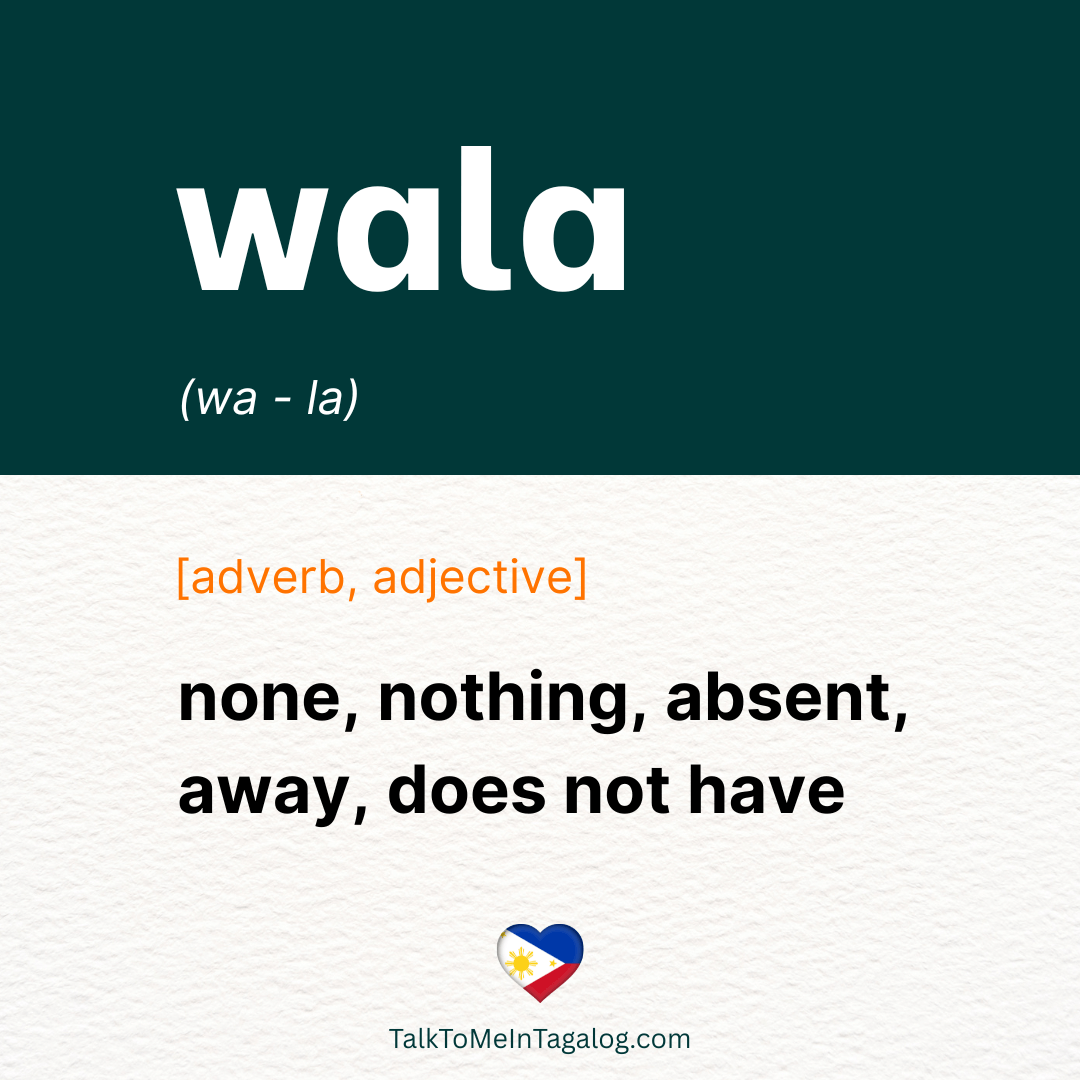
Learn how to say “none,” “nothing,” “not here,” or “don’t have” in Tagalog using the versatile word “wala.” This essential Tagalog lesson explains the meaning, grammar, and everyday uses of “wala” in Filipino conversation. You’ll discover natural sentence examples, pronunciation tips, and common beginner mistakes to avoid. Perfect for learners who want to understand Tagalog negation and expand their basic Filipino vocabulary with real, practical examples.
None in Filipino: Watch this Tagalog Tutorial Video for Beginners
Wala akong oras. (I don’t have time.)
Wala si Tito Gerry dito. (Tito Gerry is not here.)
Wala si lola sa kusina. (Grandma is not in the kitchen.)
Wala ang abogado sa opisina. (The lawyer is not in the office.)
Wala amo naming ngayon. (Our boss isn’t around today.)
Wala ang motor sa garahe. (The motorcycle is not in the garage.)
Wala ang mga kaibigan ko sa event. (My friends are not at the event.)
Wala ang kuneho sa kulungan. (The rabbit is not in the cage.)
Wala kaming bahay. (We don’t have a house.)
Wala siyang pera. (He doesn’t have any money.)
Wala akong susi sa banyo. (I don’t have the bathroom key.)
Wala kang utang sa akin. (You don’t owe me anything.)
Wala akong kinalaman doon. (I have nothing to do with it.)
Walang tao sa bahay. (There’s no one at home.)
Walang pagkain sa ref. (There’s no food in the fridge.)
Walang pasok bukas. (There are no classes tomorrow.)
Featured Filipino Word
Walang damit ang bata. (The kid isn’t wearing clothes.)
Walang gatas sa tindahan. (There’s no milk at the store.)
Wala siyang galang sa mga matatanda. (She has no respect for elders.)
Wala akong pakialam sa ‘yo! (I don’t care about you!)
Walang nakalagay na pangalan. (There’s no name written.)
Wala akong narinig. (I didn’t hear anything.)
Wala siyang sinabing masama. (She didn’t say anything bad.)
Wala akong ganang kumain. (I have no appetite.)
Wala na akong tiwala sa kanya. (I don’t trust him anymore.)
Wala na tayong oras. (We’re out of time.)
Wala na akong malinis na damit. (I don’t have any clean clothes left.)
Wala na akong load. (I’m out of phone credit.)
Wala na akong magagawa. (There’s nothing I can do anymore.)
Wala na siyang nararamdaman para sa iyo. (He doesn’t feel anything for you anymore.)
Wala kang dala? (You didn’t bring anything?)
Wala tayong kuryente? (We don’t have electricity?)
Bakit wala ka kahapon? (Why weren’t you around yesterday?)
Walang nakalagay na presyo sa tag. (The price tag is blank.)
Wala siyang sinabi sa ‘yo? (He didn’t say anything to you?)
Wala pa rin? (Still nothing?)
Walang kuwenta ang palabas. (The show was pointless.)
Walang katumbas ang hirap na dinanas niya. (Nothing compares to the hardship he went through.)
Walang duda, magaling siya. (No doubt, he’s good.)
Walang imposible. (Nothing is impossible.)
Walang sumagot sa tanong. (Nobody answered the question.)
Walang ginagawa si Mark. (Mark isn’t doing anything. = Mark is not busy.)
Wala siyang pambili ng gamot. (He doesn’t have money to buy medicine.)
Walang tubig sa gripo. (There’s no water from the faucet.)
Wala akong natanggap. (I didn’t receive anything.)
Walang nakalagay na petsa sa dokumento. (The document doesn’t have a date.)

Watch more Tagalog Learning Videos
Wondering how to say “have” in Tagalog? Learn the natural Filipino way to express possession, relationships, or experiences.
Need to say “I don’t have” in Tagalog? Learn the natural Filipino way to express lack or absence of something, with real-life sentence examples.
Want to say “there is” or “there are” in Tagalog? Learn the correct Filipino structure for stating existence or presence in everyday speech.
Connect
Our YouTube Channels
Talk to Me in Tagalog
English-Tagalog Speaking Practice
Learn Filipino Language
OFW English Lessons
Want to support us?