
How to Say “Can,” or “May” in Tagalog | PUWEDE in English
Curious how to say “can,” “may,” or “allowed to” in Tagalog? This Filipino lesson explores “puwede,” the flexible word used in the Philippines to talk about permission, ability, and possibilities. You’ll see it in real-life sentences with easy English translations, showing exactly how it fits into everyday conversation. By practicing these examples, you’ll learn to ask for permission and express what’s possible naturally, helping you speak Tagalog with confidence and fluency.
How to Say CAN or POSSIBLE in Filipino: Watch this easy Tagalog Lesson for Beginners
→ Asking for Permission
Puwede ba akong pumasok? (Can I come in?)
Puwede ba akong magtanong? (May I ask a question?)
Puwede bang umupo rito? (May I sit here?)
Puwede ko bang isukat? (Can I try it on?)
Puwede ko bang hiramin ‘to? (Can I borrow this?)
Puwede ko bang iuwi ‘to? (Can I take this home?)
Puwede ko bang gamitin ang charger mo? (Can I use your charger?)
Puwede ba akong lumabas sandali? (Can I step out for a moment?)
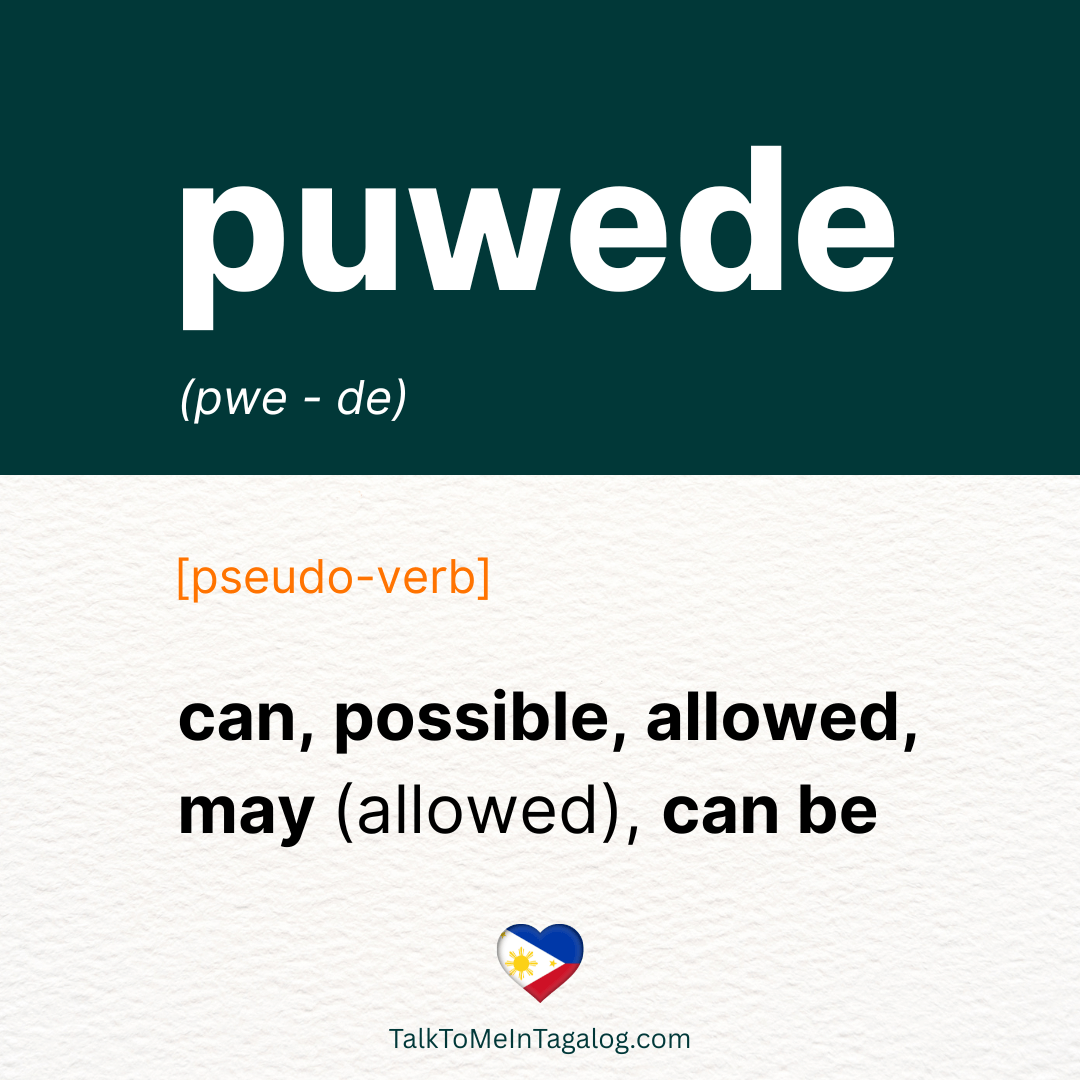
Featured Filipino Word
→ Giving Permission
Puwede ka nang umuwi. (You can go home now.)
Puwede kang magtanong sa guwardiya. (You can ask the security guard.)
Puwede kang magpahinga kung napapagod ka na. (You can rest if you’re tired.)
Puwede mong gamitin ‘yung printer. (You can use the printer.)
Puwede mong isama ang kaibigan mo bukas. (You’re allowed to bring your friend.)
Puwede kang maghintay dito habang inaayos pa. (You can wait here while it’s being fixed.)
Puwede ka na ulit maglaro, tapos ka na sa homework mo. (You can play again—you’re done with your homework.)
Puwede kang sumabay sa amin kung wala kang masakyan. (You can ride with us if you don’t have a ride.)
Puwede mong iparada ang motor mo sa likod. (You can park your motorcycle at the back.)
→ Making Suggestions or Offers
Puwede tayong maglakad kung gusto mo. (We can walk if you want.)
Puwede mong itulak kung mabigat. (You can push it if it’s heavy.)
Puwede nating putulin kung masyadong mahaba. (We can cut it if it’s too long.)
Puwede mong tawagan si Carlos para klaruhin. (You could call Carlos to clarify.)
Puwede tayong magkape pagkatapos ng meeting. (We could grab coffee after the meeting.)
Puwede nating ituloy ito sa susunod na linggo. (We could continue this next week.)
Puwede nating balikan ‘to kung may oras pa. (We could go back to this if there’s still time.)
→ Expressing Possibility
Puwede tayong abutan ng ulan dito. (We might get caught in the rain here.)
Puwede siyang tumanggi. (She might say no.)
Puwede pa siyang makahabol. (He might still make it.)
Puwede kang magkamali kung di ka mag-iingat. (You might make a mistake if you’re not careful.)
Puwede itong masira kung hindi maayos ang pagdala. (This could break if not handled properly.)
Puwede pa tayong makahanap ng mas mura. (We might still find something cheaper.)
Puwedeng lumala ang sakit mo kapag hindi ka nagpagamot. (Your condition might get worse if you don’t get treated.)
→ Expressing Prohibition or Denial
Hindi puwedeng pumasok ang walang ID. (No entry without an ID.)
Hindi ka puwedeng lumabas ngayon. (You can’t go out now.)
Hindi puwedeng dalhin sa loob ang pagkain. (Food isn’t allowed inside.)
Hindi puwedeng mag-ingay dito. (You can’t make noise here.)
Hindi puwedeng hawakan ‘yan. (You can’t touch that.)
Hindi puwedeng umalis hangga’t hindi tapos. (You can’t leave until it’s done.)
Hindi puwedeng maningil nang walang resibo. (You can’t charge without a receipt.)
Hindi mo puwedeng iwan basta-basta ang trabaho mo. (You can’t just leave your job like that.)
Watch more Tagalog Learning Videos


Learn how to say “almost” in Filipino using the word “halos” in real-life Tagalog sentences and daily conversation. This tutorial is for learners who are curious how ‘halos’ is used in expressing near actions and quantities in Tagalog. Watch now to boost your fluency with natural Filipino expressions!

Learn how to use the Tagalog pseudo-verb kaya to talk about ability, possibility, and challenges in real everyday sentences. This video is great for learners who want to understand how kaya actually works in conversation and how it fits into Filipino grammar. Watch now and start using kaya more naturally.
Connect
Our YouTube Channels
Talk to Me in Tagalog
English-Tagalog Speaking Practice
Learn Filipino Language
OFW English Lessons
Want to support us?