
How to Say "I Think" or "In My Opinion" in Tagalog | SA TINGIN KO in English
Do you want to learn how to say “I think” or “in my opinion” in Tagalog to share your views? This easy Filipino language lesson delves into “Tingin ko” (and its common variant, “Sa tingin ko”), the essential Tagalog phrase for naturally expressing thoughts and personal perspectives. You’ll learn exactly what “tingin ko” means and how Filipinos actually use it to share opinions in everyday conversation. With practical Tagalog examples and easy English translations, this lesson helps you express your thoughts naturally and speak with more confidence and authenticity.
How to Say I THINK or IN MY OPINION in Filipino: Watch this Tagalog Tutorial for Beginners
Tingin ko masarap ‘yan. (I think that’s delicious.)
Tingin ko kaya mo ‘yon. (I think you can do it.)
Tingin ko wala ng pag-asa ‘yan. (I think there’s no hope for that.)
Tingin ko mas bagay sa iyo ito. (I think this one looks better on you.)
Tingin ko matagal pa ‘yon. (I think that’s still a long way off.)
Tingin ko napahiya siya. (I think she got embarrassed.)
Tingin ko ayaw nia rito. (I think he doesn’t like it here.)
Tingin ko nahihirapan si Sally. (I think Sally is having a hard time.)
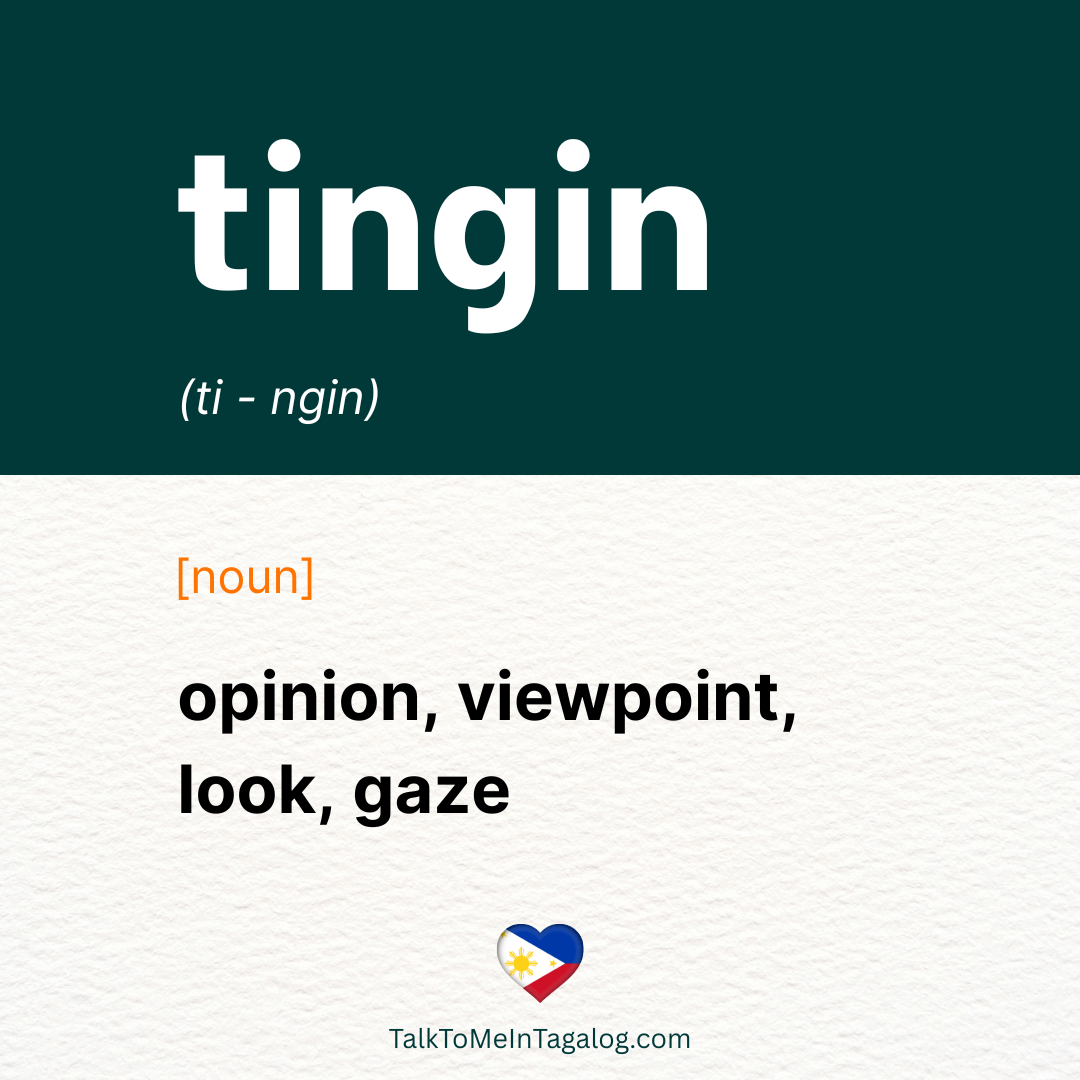
Featured Filipino Word
Tingin ko nasaktan siya sa sinabi mo. (I think she was hurt by what you said.)
Tingin ko sinusubukan naman niyang magbago. (I think he’s trying to change.)
Tingin ko gusto ka pa rin niya. (I think he still likes you.)
Tingin ko hindi niya alam ang ginagawa niya. (I think he doesn’t know what he’s doing.)
Tingin ko gusto niya nang umuwi. (I think he wants to go home already.)
Tingin ko nagsisisi na siya ngayon. (I think she regrets it now.)
Tingin ko puwede na ‘to. (I think this will do.)
Tingin ko nagpapapansin lang ‘yon. (I think he just wants attention.)
Tingin ko kuntento siya sa buhay niya. (I think she’s satisfied with her life.)
Tingin ko magkakasakit ako. (I think I’m getting sick.)
Tingin ko may mali. (I think something’s off.)
Tingin ko napilitan lang siya. (I think he was pressured into it.)

Tingin ko nagsisinungaling siya. (I think he’s lying.)
Tingin ko may problema siya. (I think she has a problem.)
Tingin ko papunta na siya rito. (I think he’s on her way here.)
Tingin ko low-batt na. (I think the battery’s dead.)
Tingin ko hindi si pupunta. (I don’t think he’s coming.)
Tingin ko may alam siya. (I think she knows something.)
Tingin ko mas masarap ang kape na walang asukal. (I think this coffee tastes better without sugar.)
Tingin ko maiintindihan naman niya kung ipaliliwanag mo. (I hink he’ll understand if you explain it.)
Tingin ko sa restawran mo naiwan ang telepono mo. (I think you left your phone at the restaurant.)
Tingin ko masyadong marami ang in-order nating pagkain. (I think we ordered too much food.)
Watch more Tagalog Learning Videos
Learn how to say “while” in Tagalog using “habang” to talk about simultaneous actions. This video shows how “habang” is used in natural Filipino sentences for everyday conversations. Watch now to speak Tagalog more smoothly and confidently!
Learn how to say “I think” in Tagalog using “yata” for soft, uncertain statements. This video explains how “yata” adds nuance in Filipino conversations with clear, natural examples. Watch now to sound more natural and expressive in Tagalog!
Learn how to say “after” in Tagalog using words like pagkatapos, matapos, and sa likod ng. This video breaks down their meanings and shows how to use them in everyday Filipino sentences. Watch now to speak Tagalog more clearly and naturally!
Connect
Our YouTube Channels
Talk to Me in Tagalog
English-Tagalog Speaking Practice
Learn Filipino Language
OFW English Lessons
Want to support us?